In the 1920s, farmers at Qantir, in the Delta, found while ploughing glazed faience tiles, blue and white, decorated with flowers and foreign captives. The antiquities dealers of Cairo fought over them. In 1928, the Egyptian Mahmud Hamza came to excavate and uncovered faience workshops in the name of Ramses II (Ramesses II). He was the first to say that the lost capital lay there, and not at Tanis.
Identification and location
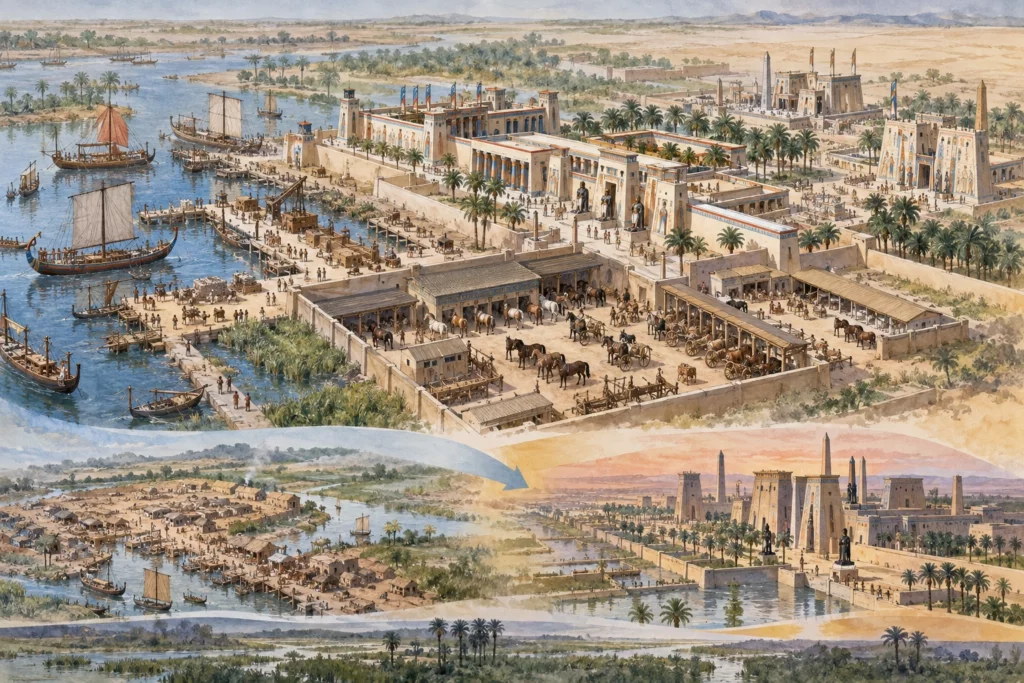
Pi-Ramses, ‘the house of Ramses’, was the capital founded by Ramses II in the eastern Delta. Its remains lie beneath the fields and the village of Qantir, a few kilometres north of Tell el-Dab’a, ancient Avaris. The new city extended the former capital of the Hyksos, on the same branch of the Nile.
The scribes of the time praised the city in poems that pupils were made to copy. Its granaries overflow, its ponds are full of fish, its ships arrive laden from every land. The Bible, for its part, keeps the memory of a store city named Ramses, built by Hebrews, in the story of the Exodus.
The city
On the surface, almost nothing. Fields, canals, a few stone blocks. But from 1996, the German team of Edgar Pusch, with the geophysicist Helmut Becker, passed magnetometers over the crops. Beneath the ground appeared a plan of astonishing clarity: streets, palaces, temples, houses, vanished waterways.
Vast stables have been identified there, with hundreds of stone rings for tethering chariot horses. Bronze workshops, where weapons were cast. And moulds for making shields of Hittite type. The army of yesterday’s enemy provided models for the Egyptian army.
Chronology and functions
The royal residence developed under Seti I, then Ramses II made it his political and military capital. The choice was no accident: the city lay at the start of the roads to Canaan and Syria, where the wars and diplomacy of the time were played out.
At the end of the New Kingdom, the branch of the Nile that served the city silted up. The kings of the 21st Dynasty settled at Tanis, some twenty kilometres to the north, and carried there obelisks, statues and columns. Other blocks went to Bubastis. Pi-Ramses became a quarry.
Excavations and the history of research
For a long time, Tanis was thought to be Pi-Ramses, because of the monuments of Ramses II that abound there. Pierre Montet was convinced of it. It took the excavations of Manfred Bietak at Tell el-Dab’a, from 1966, and those of Edgar Pusch at Qantir, for the Hildesheim museum from 1980, to establish that the stones of Tanis came from elsewhere.
State of preservation and research questions
The remains are still buried beneath farmland, and the village is spreading. Each excavation season has to contend with the crops and the water table. For a monument, one must also always distinguish the date it was sculpted, the date it was transported and the date it was reused at Tanis.
Research now focuses on the overall plan of the city, its craft districts and its water network, which governed its life and caused its end.
Sources
Main sources (consulted on 28 September 2026): Austrian Archaeological Institute, Tell el-Dab‘a; Metropolitan Museum of Art, object from Qantir; Edgar B. Pusch, ‘Pi-Ramesse-Beloved-of-Amun, Headquarters of Thy Chariotry’, in Pelizaeus-Museum Hildesheim. The Egyptian Collection, Mainz, Philipp von Zabern, 1996.