In brief
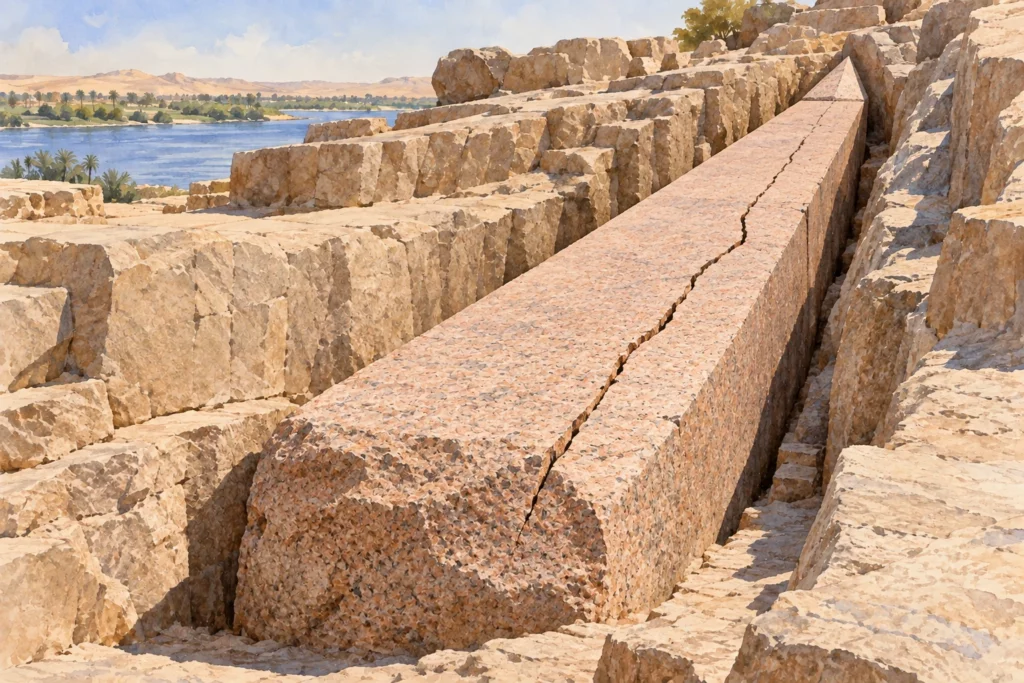
At Aswan, on the east bank of the Nile, the granite quarries supplied for centuries the stone for Egyptian obelisks, colossi and sarcophagi. In one of them, an obelisk has remained lying in the rocky bed where it was being cut. Finished, it would have reached about 42 metres and weighed nearly 1,168 tonnes according to the Egyptian Ministry of Tourism and Antiquities, which would have placed it above all known obelisks. Cracks that appeared in the stone led to the work being abandoned, and it now offers a rare cross-section of the work of pharaonic quarrymen.
What you discover
The monument reads first as a long silhouette hollowed out of the pink granite. Reginald Engelbach, inspector of the Antiquities Service who directed its clearance, gives it a length of 41.75 metres and a width of 4.20 metres at the base, with a planned pyramidion (the tip) 4.50 metres high. Three faces are free; the lower face is still one with the rock. A trench about 75 centimetres wide runs around the block; a photogrammetric survey published in 2023 measures its maximum depth at about 5.2 metres. According to Engelbach, the workers had dug only about two thirds of the depth needed to detach the obelisk.
The work site is not isolated. Above the quarry face, Engelbach identified the bed of a smaller obelisk, about 7 metres long, and fragmentary hieratic inscriptions painted in red on the wall. The quarries were worked for a long time: not all the visible traces around belong to the same project.
What to look at
The most telling detail lies in the surface of the trench walls, covered with rounded, parallel hollows. They were left by dolerite pounders, balls of a rock harder than granite, weighing about 4 to 7 kilograms according to Engelbach, with which the quarrymen reduced the stone to dust. An experiment carried out near the site by Marián Marčiš and Marek Fraštia, with a pounder of 3.47 kilograms, removed only about 216 cubic centimetres of granite per hour. The authors conclude that cutting with dolerite alone would have been very slow, and that other methods must have been combined with it.
Look also for the lines painted in red and black. Engelbach measured an average spacing of 29.9 centimetres between the vertical red strokes, which he interprets as a double foot, and sees in them markers recording the depth reached by successive teams. Finally, the cracks themselves can be followed by eye: Engelbach designated them by letters and showed that two of them, where they met, already made it necessary to shorten the monolith by at least half a metre. Other flaws then doomed the project.
Its history
Cut in a single piece, the obelisk was topped by a gilded pyramidion that reflected the rays of the sun; it is linked to solar mythology and to the benben, the first land to emerge at the beginning of the world. The one at Aswan, buried under sand, was cleared at the beginning of the 20th century. Engelbach undertook the work after the visit of King Fuad in the winter of 1920–1921; a second season followed in the winter of 1921–1922, and the study appeared in 1922 from the press of the Institut français d’archéologie orientale (IFAO, French Institute for Oriental Archaeology).
The date of the work remains uncertain. The Egyptian ministry attributes the commission to Hatshepsut (c. 1473–1458 BC), for the temple of Amun at Karnak, but no dedication inscription appears on the block and Engelbach himself wrote that he had found nothing giving a real clue to its date. The attribution therefore remains a hypothesis based on the context of the great obelisks of the New Kingdom.
Sources
Consulted on 30 September 2026: The Unfinished Obelisk, Egyptian Ministry of Tourism and Antiquities; Reginald Engelbach, The Aswân Obelisk, with Some Remarks on the Ancient Engineering, Cairo, Imprimerie de l’Institut français d’archéologie orientale, 1922 (digital edition, Project Gutenberg); Marián Marčiš and Marek Fraštia, ‘The problems of the obelisk revisited’, Digital Applications in Archaeology and Cultural Heritage, 30, 2023.