Identification and location
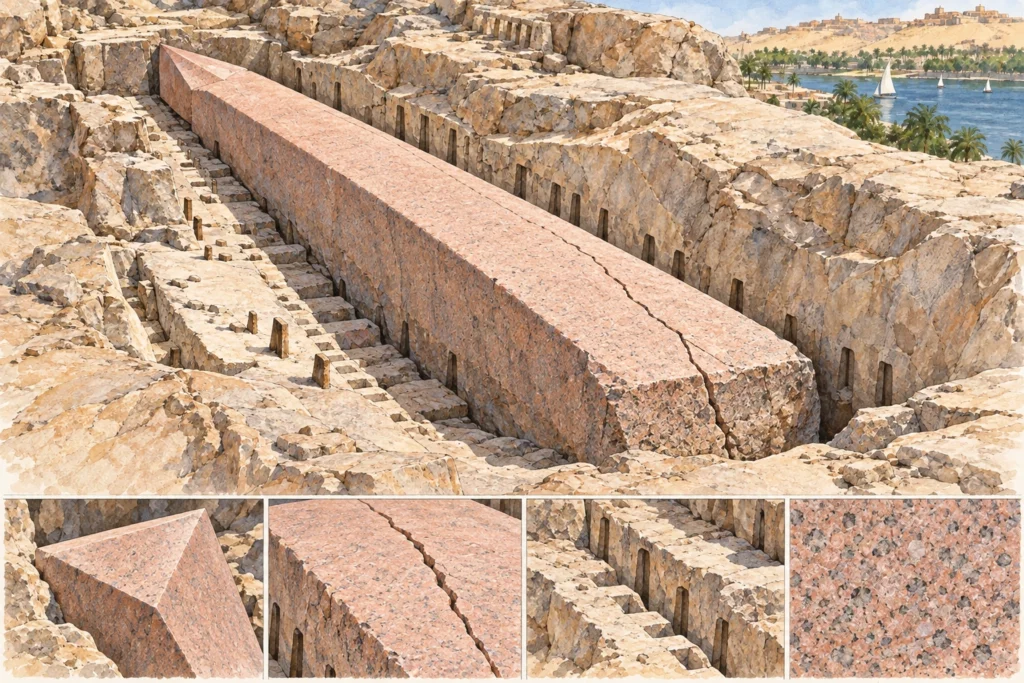
The granite quarries of Aswan extend along the east bank of the Nile, in the area of the First Cataract. Throughout pharaonic history they supplied a pink and grey granite much sought after for obelisks, colossi, sarcophagi and architectural elements. In the northern quarry, the unfinished obelisk has remained lying in the rock, at the very spot where it was being cut.
The monument
According to the Egyptian ministry, the obelisk would have reached about 42 m in height and a weight of about 1,168 tonnes had it been finished: it would have been the largest obelisk ever erected in Egypt. It is cut in a single piece, on three faces, and remains attached to the rock by its lower face.
The work was abandoned because of flaws in the stone and several cracks that appeared during extraction. The monument was therefore never detached, transported or raised.
Chronology and attribution
The Egyptian ministry states that it was commissioned by Hatshepsut (c. 1473–1458 BC) for the temple of Amun at Karnak. No inscription appears on the block: this attribution rests on the context of the great obelisks of the 18th Dynasty and remains a hypothesis.
Cutting techniques
The trench walls preserve the traces of the work: the quarrymen freed the block by pounding the granite with balls of dolerite, a harder rock. Lines and markers are still visible on the stone. The monument thus offers a rare cross-section of an interrupted pharaonic work site.
Rediscovery and research
Covered with sand, the obelisk was cleared at the beginning of the 20th century; the work of the Egyptologist Reginald Engelbach, in the 1920s, made it a reference for the study of extraction techniques. The neighbouring quarries preserve other roughed-out monuments and quarrymen’s inscriptions.
State of preservation and research questions
The site is laid out as an open-air museum. Research focuses on the organisation of the work, the tools and the method of transport envisaged; reconstructions of the moving of the obelisk remain hypotheses, since this block was never moved.
Sources
Main sources (consulted on 28 September 2026): Egyptian ministry, the unfinished obelisk; Egyptian ministry, Aswan; UNESCO, Nubian Monuments from Abu Simbel to Philae.