Identification and location
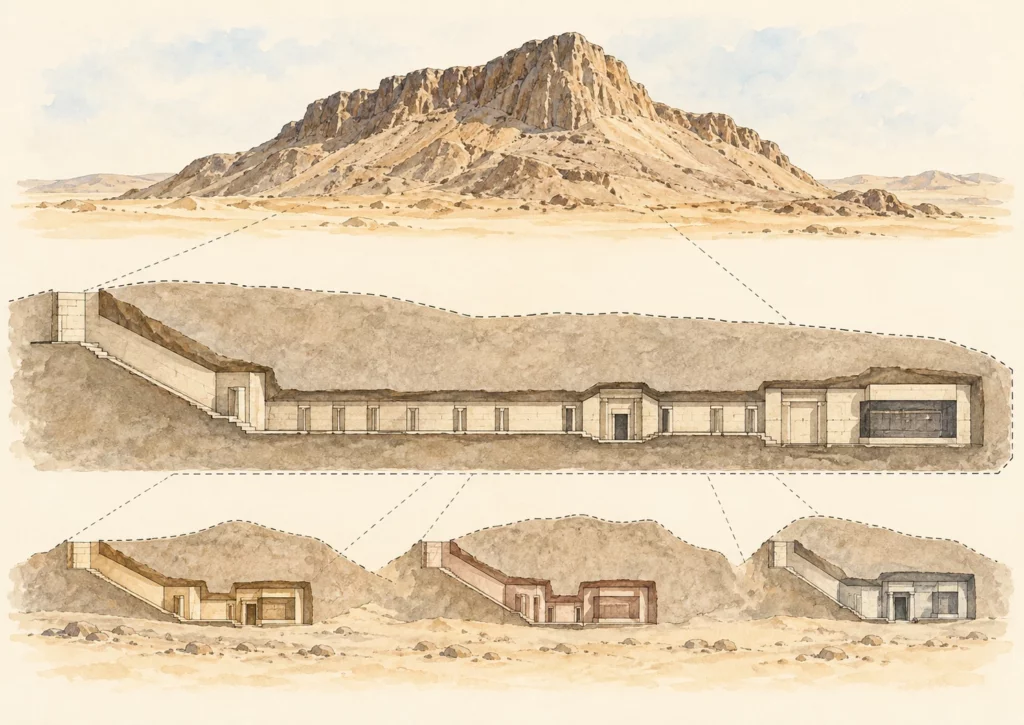
The Mountain of Anubis is a peak in the desert of South Abydos, associated in ancient texts with the royal funerary landscape. Senusret III chose this place for a great underground tomb in the Middle Kingdom. The Penn Museum specifies that the monument, discovered in 1902, extends underground for about 180 m, some 30 m below the desert surface. This figure describes the tomb studied; it should not be applied to the later tombs of the area. The project also included a funerary temple and a community responsible for the cult. The tomb of Senusret III was at first considered a cenotaph, partly because the king also had a pyramid at Dahshur. The excavations carried out between 2008 and 2014 have provided, according to the Penn Museum team, significant archaeological evidence in favour of an actual burial at Abydos. This conclusion qualifies older accounts that automatically placed the body in the pyramid at Dahshur. The case must set out the data and the development of the interpretations without turning the absence of a complete mummy into definitive proof.
General presentation
Scholars have linked the underground architecture and the presence of the natural peak with a development in ideas of the royal afterlife. The peak may have served as a landscape image of rebirth and foreshadowed the choice of hidden tombs in the Valley of the Kings. This is a historical analysis of the arrangement, not a proven plan for all later monuments. The tomb of Senusret III is a transitional form in the long history of royal burials.
Monuments and remains
The temple of Nefer-Ka maintained the king’s cult and formed a local institutional centre. The remains around it provide data on its economy and administration. The place of worship and the underground tomb were linked without being superimposed. This separation is part of the organisation of the Abydos complex and helps to avoid the idea that each building visible on the surface directly marks a burial chamber beneath it.
Chronology and building phases
During the Second Intermediate Period, other kings chose the area. The research of 2013–2014 identified Senebkay, attributed to an Abydos dynasty, and several neighbouring tombs. This group shows that the place retained its power of memory after Senusret III. The tombs of the more modest rulers are not, however, simply reduced copies of his monument. Their materials, reuses and chronologies must be established tomb by tomb.
History and functions
The discovery of Senebkay illustrates how an excavation can change the political history of the Second Intermediate Period. A local dynasty that was previously hardly visible gains an archaeological anchor. The royal names and the objects found in the chambers are direct sources, but the sequence of all the reigns remains debated. The identification of a king, the dating of his tomb and the reconstruction of a complete list of rulers must be kept distinct.
Excavations and the history of research
The Penn Museum excavations combine the study of the tomb of Senusret III, the temple, the associated quarters and the later burials. Looting, reuse and erosion affect each context. The landscape visible today does not reveal to the naked eye the length or depth of the corridors. The project’s scientific sections and plans are essential for locating a chamber precisely and its relationship to the natural relief.
What we still do not know about the tomb of Senusret III
According to the Penn Museum, the tomb remains largely unexcavated: most of it is still filled with debris left by the work of 1902–1903. The sealed entrance was reopened in 2005, after 102 years of closure, and the photographic and architectural surveys revealed errors in the old plans.
The central question remains that of the king’s burial at Abydos, which has not been settled. The researchers also hope to determine when and how the tomb was looted, as the systematic clearance of the galleries continues.
Sources
Main sources: Penn Museum, ‘Abydos Archaeological Project’, https://www.penn.museum/research/project.php?pid=19; Josef Wegner, ‘Discovering Pharaohs Sobekhotep & Senebkay’, https://www.penn.museum/sites/expedition/discovering-pharaohs-sobekhotep-senebkay/; Beneath the Mountain-of-Anubis, Penn Museum; Penn Museum, press release on Senebkay, https://www.penn.museum/about/press-room/press-releases/senebkay-forensic-evidence (consulted on 27 September 2026).