In brief
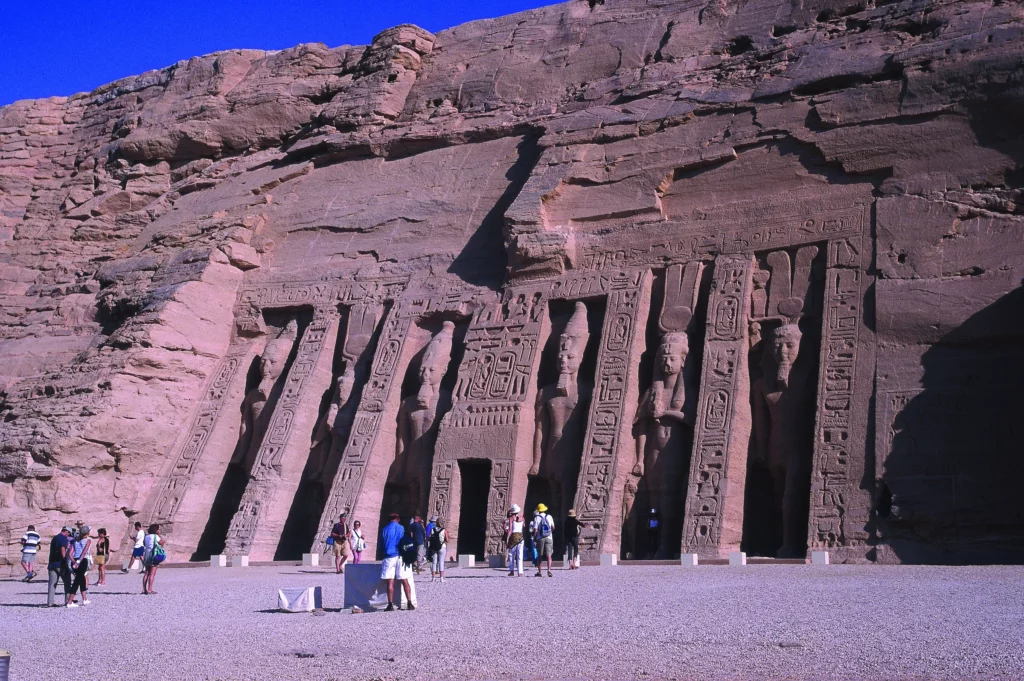
The small temple of Abu Simbel was built by Ramses II (Ramesses II) for the goddess Hathor and for Nefertari, his great royal wife. It stands some distance north of the great temple, on the same escarpment on the west bank of the Nile, in Lower Nubia. Like its neighbour, it belongs to the property Nubian Monuments from Abu Simbel to Philae, inscribed on the World Heritage List in 1979.
What you discover
The façade bears six standing statues cut from the rock, two of which depict the queen. They frame the entrance and set the royal couple at the scale of the landscape. Inside, a hall with Hathor pillars precedes deeper rooms and the sanctuary dedicated to the goddess. The scenes show Nefertari in the presence of the deities and the king, in a ritual role that the iconography grants her without raising her to the rank of a reigning sovereign.
The temple shared the fate of the great one: it was moved with it in 1968, as part of the international campaign led by UNESCO. The two monuments now stand 64 m above their old site, on a hill built to receive them. The visual link between them, dictated by the original terrain, has thus been carefully reconstructed.
What to look at
The Egyptian Ministry of Tourism and Antiquities points out a precise detail: the colossi of Nefertari are the same size as those of her husband, a very rare example for a queen. Comparing, on the façade, the height of the female figures with that of the royal figures is enough to measure the significance of the choice. In Egyptian art, the wife is usually shown at a reduced scale, at the king’s leg; here, equal size is a deliberate message.
Note also the small figures of royal children standing between the great statues. Their deliberately modest scale makes the monumentality of the couple stand out even more. This reading is that of the visible composition; it does not tell us what the contemporaries of Ramses II thought of it.
Its history
Hathor is at the centre of the cult of the place, associated with the queen in a programme that celebrates both divine protection and the function of the royal wife. The word small is relative: it contrasts this temple with the great one, not with the quality of its programme. The two buildings answer each other: the great temple honours the king among the gods of the state, the small temple highlights the goddess and the queen. This pairing is a modern reading, based on the dedications and the decoration, not a plan set out in an ancient text.
It should not be concluded that Nefertari shared the power of Ramses II. The images honour her ritual and dynastic role; they make no other claim. The value of the monument lies in this way, rare for the period, of publicly displaying the queen’s place beside the king, on a frontier where Egypt put itself on show.
Sources
Consulted on 30 September 2026: Abu Simbel, Egyptian Ministry of Tourism and Antiquities; Working Together: Abu Simbel, UNESCO World Heritage Centre; Nubian Monuments from Abu Simbel to Philae, UNESCO.