In brief
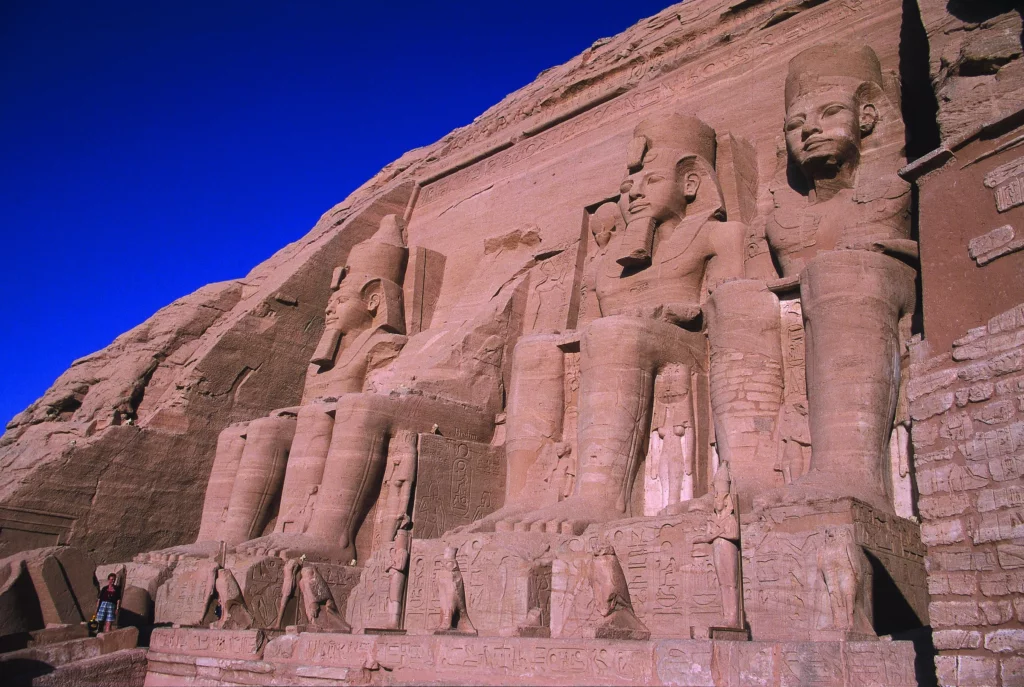
The great temple of Abu Simbel is a rock-cut temple of Ramses II, carved into an escarpment of hard rock on the west bank of the Nile, about 280 km south of Aswan. Its façade is dominated by four seated colossi of the king, 21 m high. The sanctuary brings together four figures: Amun-Ra, Ra-Horakhty, Ptah and the deified Ramses II. The work dates from the 13th century BC; the Egyptian Ministry of Tourism and Antiquities places its completion around 1264 BC.
What you discover
The monument first appears as a façade cut into the cliff, with no court or pylon built in front of it. Behind the door, great standing colossal statues line the main hall, then the route goes deeper towards the sanctuary, on the axis of the entrance. This progression from light to darkness is the very structure of the Egyptian temple, here inscribed in the rock rather than built in blocks.
Today’s visitor, however, is not standing at the original location. During the campaign to save the monuments of Nubia, more than a thousand blocks, each weighing about 30 tonnes, were numbered, stored and then rebuilt 64 m above the old site and 180 m inland. Dismantling began in November 1963 and the monument was inaugurated at its new location on 22 September 1968. The operation cost 80 million US dollars, half of which was provided by some fifty countries.
What to look at
At the foot of the façade, the fragments of one of the four colossi recall that it collapsed in Antiquity, after damage attributed to an earthquake: the present façade is therefore not the one inaugurated under Ramses II, and the record of its damage is part of its history.
The second detail concerns light. Two days a year, 22 February and 22 October according to the Egyptian ministry, the sun’s rays enter the temple, cross the great hall and light up the statues at the back. UNESCO describes the same phenomenon at the equinoxes, which shows that the wording is approximate. The sources consulted do not say whether the dates were the same before the move of 1963–1968, nor what exact value the builders gave to this alignment; one should therefore speak of a remarkable orientation without turning it into astronomical proof.
Its history
The temple belongs to the policy of Ramses II in Nubia, a region where Egypt had been established for centuries: it associates with the great gods of the state a king who had himself depicted among them in the sanctuary. Its façade, visible from afar from the river, was an assertion of power as much as a place of worship.
Its inscription on the World Heritage List in 1979, with all the Nubian monuments from Abu Simbel to Philae, also recognises a modern history: the international campaign of 1960 to 1980 preserved 22 monuments and complexes, with some forty technical missions from five continents. Abu Simbel is its symbol, to the point that the image of the relocated temple has become inseparable from that of the ancient temple.
Sources
Consulted on 30 September 2026: Abu Simbel, Egyptian Ministry of Tourism and Antiquities; Working Together: Abu Simbel, UNESCO World Heritage Centre; Nubian Monuments from Abu Simbel to Philae, UNESCO.