Identification and location
The small temple of Abu Simbel, cut into the cliff north of the great temple, is dedicated to the goddess Hathor of Ibshek and to the great royal wife Nefertari. It belongs to the same programme of Ramses II (Ramesses II) and to the same World Heritage property. Like its neighbour, it was cut up and rebuilt higher up between 1964 and 1968.
Architecture and decoration
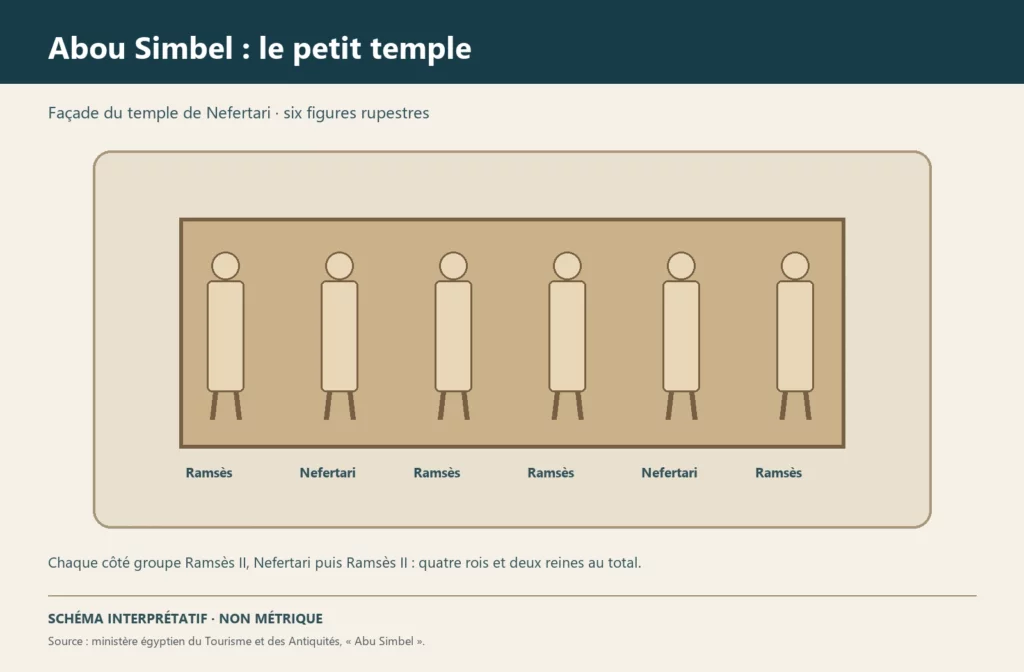
The façade, sloping like a pylon, has six standing statues about ten metres high, cut from the rock: four represent Ramses II, two the queen. Small princes and princesses stand beside them. The Egyptian ministry stresses that the colossi of Nefertari are the same size as those of the king, which is exceptional for a queen.
The interior, simpler than that of the great temple, comprises a hall with six pillars whose faces bear heads of Hathor, topped by sistra. A transverse vestibule flanked by two small rooms leads to the sanctuary. In the niche at the back, the cow of Hathor seems to emerge from the mountain to protect the king. The reliefs show Nefertari making offerings to the gods, including a scene in which she is crowned by Hathor and Isis.
Chronology and functions
The temple dates from the same period as the great temple, in the first half of the reign of Ramses II. It combines the cult of Hathor, goddess of love and music and protector of distant regions, with the glorification of the queen. Nefertari is shown with divine attributes, without being a reigning sovereign: the whole expresses the ritual role of the queen beside the king.
The juxtaposition of the two temples forms an overall programme: the great temple celebrates the king among the gods of the state, the small temple the goddess and the royal wife. This pairing remains a modern reading, based on the dedications and the decoration.
Rediscovery and research
Less buried in sand than the great temple, the small temple was seen by Jean-Louis Burckhardt in 1813. Its inscriptions and reliefs were copied in the 19th century, then documented again before the move. These early records make it possible to assess the state of the surfaces before the work of the 1960s.
State of preservation and research questions
The colours are partly preserved in the inner rooms. The cutting has left visible joints, and the hill that shelters the temple is artificial. Research focuses on the place of the queen in Ramesside ideology and on the links between this temple and the other sanctuaries of Hathor in Nubia.
Sources
Main sources (consulted on 28 September 2026): Egyptian Ministry of Tourism and Antiquities, Abu Simbel; UNESCO, Nubian Monuments from Abu Simbel to Philae; UNESCO, International Campaign to Save the Monuments of Nubia.