Identification and location
The great temple of Abu Simbel is a rock-cut temple of Ramses II (Ramesses II), carved into a sandstone promontory on the west bank of the Nile, in Lower Nubia, about 280 km south of Aswan. With the temple of Hathor and Nefertari, a few dozen metres further north, it forms one of the major groups of the property Nubian Monuments from Abu Simbel to Philae, inscribed on the World Heritage List in 1979.
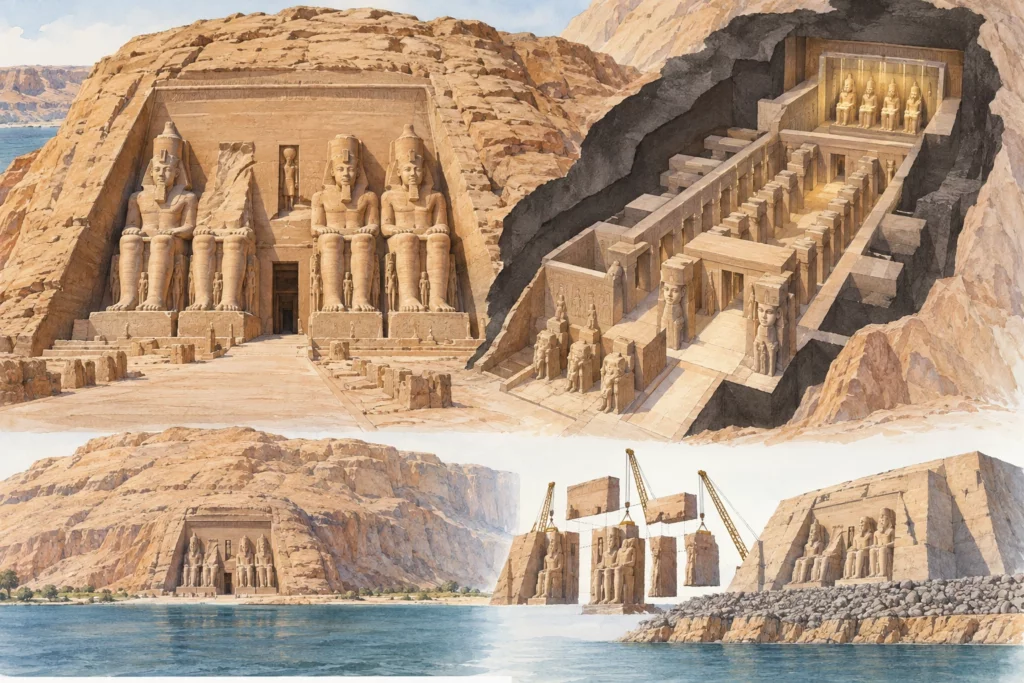
The monument visible today is no longer exactly at its original location: it was cut up and then rebuilt, between 1964 and 1968, some sixty metres higher, against an artificial hill.
Architecture and decoration
The façade, cut into the rock, is dominated by four seated colossi of the king, about twenty metres high. The second colossus from the south collapsed in Antiquity, probably as a result of an earthquake; its fragments have remained at the foot of the façade. Between the legs and near the thrones are members of the royal family, including Nefertari and the queen mother Tuya. A row of baboons adoring the rising sun crowns the façade.
Inside, the plan goes deep into the mountain along a single axis. The great hall is punctuated by eight pillars in front of which stand statues of the king in Osirian form. Its walls bear the great reliefs of the battle of Qadesh against the Hittites, as well as scenes of campaigns in Syria, Libya and Nubia. A second pillared hall and a vestibule precede the sanctuary, where four seated statues cut from the rock represent Ptah, Amun-Ra, the deified Ramses II and Ra-Horakhty. Side rooms, opening off the great hall, probably served as storerooms.
Chronology and functions
The work dates from the reign of Ramses II (c. 1279–1213 BC); the Egyptian ministry places its completion around 1264 BC. The temple combines the cult of the great gods of the state with that of the king himself, present among the deities of the sanctuary. Set in Nubia, a territory conquered and exploited for its resources, it also asserts Egyptian domination over the region.
The orientation of the axis allows the rising sun to reach the sanctuary twice a year, around 22 February and 22 October according to the Egyptian ministry. The statue of Ptah, a god linked to the underworld, traditionally remains in shadow. These present-day dates take account of the modern move; the exact meaning the ancients attached to the phenomenon remains debated.
The temple continued to be visited after Ramses II: mercenaries in the army of Psamtik II, passing through around 591 BC, carved graffiti in Greek, Carian and Phoenician on the southern colossi.
Rediscovery and research
Buried in sand for centuries, the great temple was reported in 1813 by the Swiss traveller Jean-Louis Burckhardt, who saw only the top of the façade. Giovanni Battista Belzoni cleared the entrance and went inside in 1817. The surveys of the 19th century, notably those of the Franco-Tuscan and Prussian expeditions, provided the first copies of the reliefs, including the account of Qadesh, now compared with other versions of the same text at Luxor, the Ramesseum, Abydos and Karnak.
The rescue of 1964–1968
The building of the Aswan High Dam threatened to swallow the monument beneath Lake Nasser. As part of the international campaign launched by UNESCO in 1960, the two temples were cut into more than a thousand blocks, then rebuilt on a higher site. The mountain that shelters them is now an artificial structure, of concrete covered with rock, which reproduces the appearance of the original promontory.
This operation preserved the decoration, but it changed the relationship with the river and the cliff. The cutting joints remain visible in places; they belong to the modern history of the monument.
State of preservation and research questions
Current questions concern the conservation of the painted reliefs, the management of visitor numbers and the reading of the phases of the work. The Qadesh reliefs are an official version of a clash whose outcome was more uncertain than royal propaganda suggests. They are studied by comparing the different versions of the text and the image.
Sources
Main sources (consulted on 28 September 2026): Egyptian Ministry of Tourism and Antiquities, Abu Simbel; UNESCO, Nubian Monuments from Abu Simbel to Philae; UNESCO, International Campaign to Save the Monuments of Nubia.