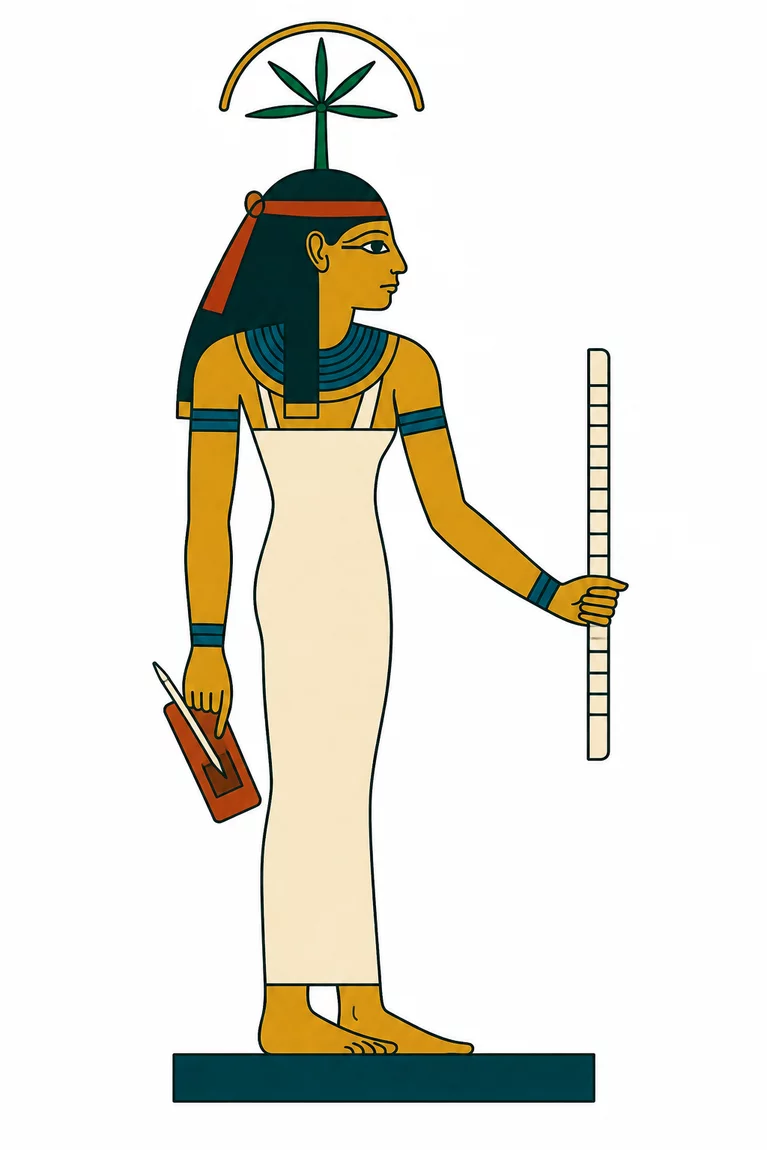
Writing a name, counting riches, keeping the memory of a reign, laying out a temple: Seshat watches over these acts that give the world a lasting form. Beside Thoth, she embodies another divine presence of writing, attentive to measurement and record-keeping.
The goddess who writes and counts
The name Seshat means ‘the female scribe’. Her domain brings together writing, accounts and censuses: activities that make it possible to keep and organise information. A number written down can be found again; an event recorded can be handed on. To understand this goddess, then, we must look at what she does as much as at the signs that distinguish her.
In temple decoration she records in particular the official names of the ruler and the booty brought back from his campaigns. These scenes give the act of writing a royal and religious significance. The king’s name, his possessions and his achievements take their place in a memory placed under the protection of the gods. The Metropolitan Museum entry describes these functions.
How do you recognise Seshat?
Seshat appears in female form. Her most distinctive attribute is a radiating emblem placed above her head, usually described as a seven-pointed star or rosette topped by an arched sign. She is often dressed in a feline skin. In some scenes she inscribes the years of the reign on a notched palm rib.
The illustration on this page offers a simplified silhouette, with a scribe’s palette and a graduated rod to evoke writing and measurement. It is a contemporary creation. On an ancient relief, the neighbouring inscriptions and the act being performed help to pin down the goddess’s identity and function.
Stretching the cord: giving the temple its measure
Before a temple was built, Seshat accompanied the king in the rite called ‘stretching the cord’. The scene shows them laying out the plan of the future building. This act links the measurement of the building to its sacred foundation: the place intended for the gods must be given a right arrangement. This function also makes Seshat a protector of builders and architects.
Writing and building meet here. In one case a name or a quantity is fixed; in the other, the limits of a space. This parallel helps to read the functions of Seshat: the exactness of the act matters, whether it leaves an inscription or the outline of a monument.
Seshat and Thoth: writing and its memory
Thoth and Seshat share the domain of writing and knowledge. Their ties vary from tradition to tradition; a single family relationship is not enough to sum up how they relate. The place of Seshat beside the king highlights above all the recording of names, of goods and of the time of the reign.
A spoken word can disappear with those who heard it. An inscription remains available to other readers. Seshat allows us to approach this dimension of writing: giving knowledge a support, keeping a trace and making its transmission possible.
And the creation of writing?
In Egyptian religious thought, writing belongs to the domain of the gods; Thoth is a great tutelary figure of it, and Seshat protects some of its essential uses. Archaeology asks another question: when did humans begin to write? The first attestations of Egyptian writing go back to the end of the 4th millennium BC, around 3200 BC, notably at Abydos. The British Museum presents this early evidence.
We can thus speak of Seshat as a goddess of writing without crediting her with a documented historical invention. Her figure expresses the value placed on the acts of writing, measuring and keeping memory.
Sources and references
- Metropolitan Museum, Head of a Goddess, inv. 08.202.44: head of a goddess probably identified as Seshat; writing, royal record-keeping and foundation rite.
- British Museum, Early Egypt: the first attestations of Egyptian writing.
Reference works
- Richard H. Wilkinson, The Complete Gods and Goddesses of Ancient Egypt, London, Thames & Hudson, 2003, entry Seshat
- Christian Leitz (ed.), Lexikon der ägyptischen Götter und Götterbezeichnungen, 8 vols, Leuven, Peeters, 2002–2003 (Orientalia Lovaniensia Analecta 110–116 and 129)