In brief
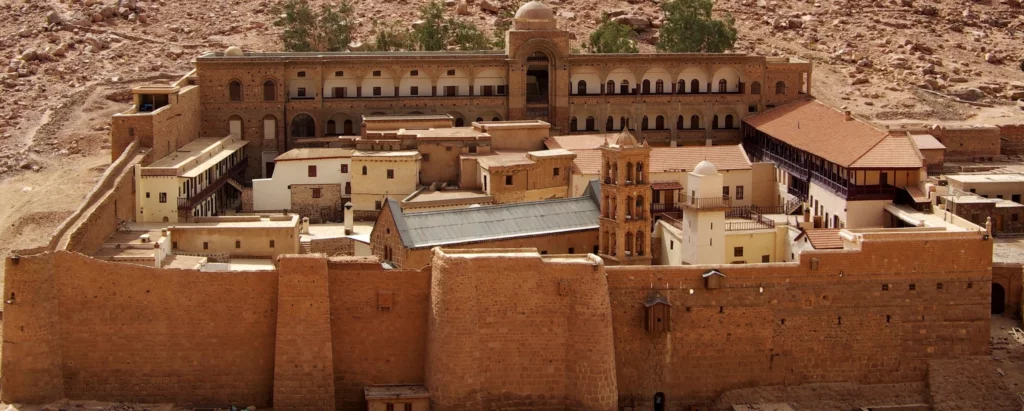
Saint Catherine’s Monastery rises in southern Sinai, at the foot of Gebel Musa, which tradition identifies with Mount Horeb, the biblical Mount Sinai. Founded in the 6th century, it is, according to UNESCO, the oldest Christian monastery still used for its original function. It has been on the World Heritage List since 2002, as part of a vast whole, the Saint Catherine Area, where mountain and holy places form a single landscape, sacred to Christianity, Islam and Judaism.
What you discover
A fortified enclosure contains a dense group: the main church, chapels, the monks’ quarters, a refectory, an olive press, an ossuary and a small Fatimid mosque of the 12th century, added long after the foundation. The juxtaposition of church and mosque in the same enclosure sums up the history of a shared place. A bush venerated as the Burning Bush is now protected by a fence: visitors who tore off sprigs were threatening its survival.
The community has remained alive for fourteen centuries. Successive repairs and additions, made with local materials, have changed the appearance of the buildings: the present image of the monastery is not that of the 6th century, even though the original enclosure and church remain.
What to look at
Look towards the apse of the church. Its semi-dome and the arch framing it bear a 6th-century mosaic of the Transfiguration of Christ, one of the great ensembles of early Byzantine art. It nearly disappeared. A restoration was carried out from 2005 to 2010 by the Centro di Conservazione Archeologica in Rome, under the direction of Roberto Nardi and the supervision of the Supreme Council of Antiquities. At that time, much of the setting bed had come away from the masonry, the figure of Christ stood ten centimetres away from the wall, and some 20,000 original tesserae had been lost.
The second treasure is the icons. Several go back to the 6th century and are among the oldest preserved in the Byzantine world. Their survival is explained by the isolation of the monastery, which remained apart from the destruction of Iconoclasm in the 8th and 9th centuries.
Its history
Hermits lived in the region long before the emperor Justinian had the fortified monastery built in the 6th century. The main church is dedicated to the Transfiguration; the monastery took only later the name of St Catherine of Alexandria, a martyr of the early 4th century whose body the monks say they found in the 9th century on a nearby mountain. Moses, the Burning Bush and Catherine thus belong to the spiritual memory of the place; the dating of the buildings, for its part, rests on inscriptions and the study of the masonry.
The site remains fragile. UNESCO points to rockfalls that threaten the walls, the risk of floods and the pressure of tourist numbers that disturbs the peace and integrity of the place.
Sources
Consulted on 30 September 2026: Saint Catherine Area, UNESCO World Heritage Centre; Stephanie Caruso, ‘Conservation of the Sixth-Century Mosaics at the Church of the Monastery of Saint Catherine at Mount Sinai’, Metropolitan Museum of Art, 2012; ‘Hallowed Ground at the Getty Center’, J. Paul Getty Trust.