Identification and location
Serabit el-Khadim lies on a plateau in south-western Sinai. The nearby mines produced mainly turquoise in the Middle Kingdom, while the region also supplied copper ores. Hathor received there the epithet ‘mistress of turquoise’. The construction of the sanctuary is attested in the Middle Kingdom and its use continued into the New Kingdom. The link between the temple and the mines is close, but the installations of the plateau, the galleries and the votive monuments belong to different phases that must be identified separately. The expeditions from the Nile Valley mobilised leaders, craftsmen and workers. Rock inscriptions and stelae record names, titles and reigns, providing anchor points for the history of exploitation. These texts also show a desire for remembrance and divine favour: they are not a complete register of the quantities extracted or of all the people present. The IFAO has reported a rediscovered inscription of the end of the reign of Amenemhat II near the turquoise mines, which sheds light on the Chapel of the Kings and shows that the documentation continues to grow.
General presentation
The temple of Hathor included spaces for worship and accumulated stelae and votive objects. The offerings studied by the Metropolitan Museum of Art include New Kingdom faience fragments associated with expedition leaders. Their date should not be carried back to the Middle Kingdom foundations. Likewise, a stela of Amenemhat III kept in the British Museum was found on a ridge south-west of the temple; its commemorative formula aimed at the lasting presence of its dedicator beside the goddess, not at the location of his burial.
Monuments and remains
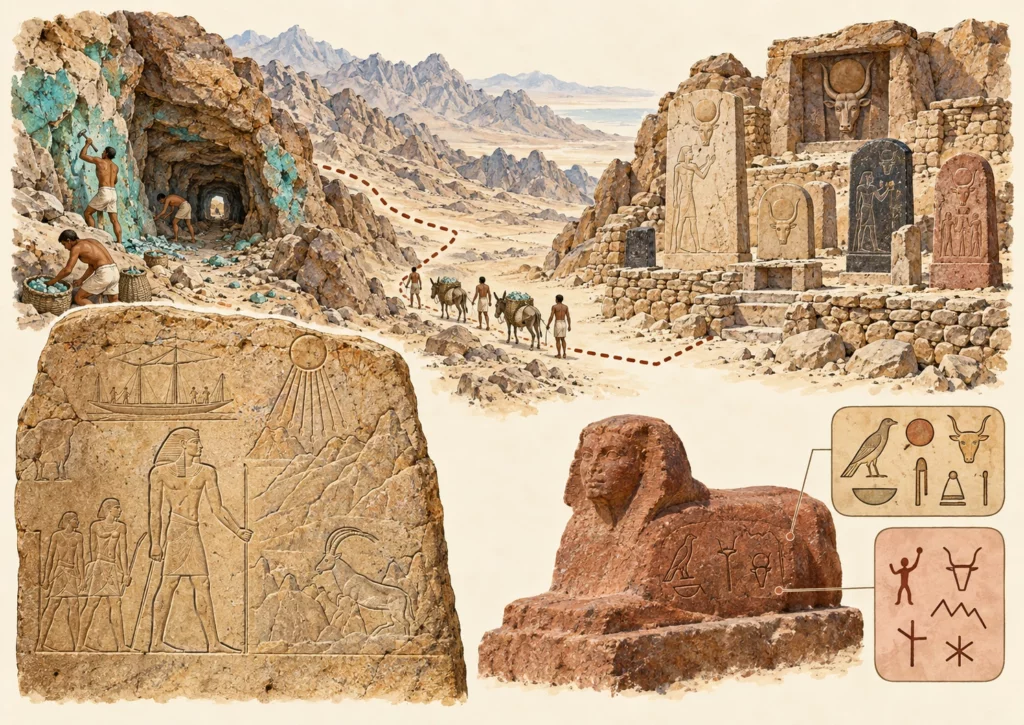
The galleries and outcrops of the plateau were worked at different times. Turquoise, known in Egypt before the Middle Kingdom, was used more abundantly then, according to the Met. Copper and other resources of Sinai belong to a longer history of exploitation. An illustration of workers, baskets and blocks of turquoise helps to explain the mining process but does not give a single method of extraction or the exact composition of an attested team. The archaeological data must be placed mine by mine.
Chronology and building phases
The Proto-Sinaitic inscriptions are of particular importance in the study of the first alphabetic scripts. The red sandstone sphinx in the British Museum bears a hieroglyphic dedication to Hathor and Proto-Sinaitic signs. The museum places it rather at the end of the Middle Kingdom, while recalling the uncertainty of its date and of its original location in the temple. The signs are often interpreted as derived from Egyptian forms and linked to a Semitic language; the phonetic values and the exact history of each text remain subjects of research.
History and functions
Flinders Petrie’s discoveries in 1904–1905 played a major role in the study of the sanctuary and the inscriptions. The objects he collected are now in several collections; where they are displayed should not be confused with their archaeological provenance. Old publications must also be compared with modern revisions of dating, as for the British Museum sphinx. The same words Serabit el-Khadim may designate the plateau, the mines, the temple or a specific area: precision about context determines interpretation.
Excavations and the history of research
The temple was a place where expeditions asked for or gave thanks for the protection of the goddess. The stelae made the participants known and set their actions in a sacred landscape. The existence of inscriptions of varied forms bears witness to linguistic and cultural contacts on the plateau, without demonstrating that all the groups wrote or worked together at the same date. The chronology of a relief, a mine and a dedication must be built from the royal names, the context of discovery and the epigraphic analysis specific to each document.
What we still do not know about Serabit el-Khadim
UCL describes a temple of Hathor, ‘mistress of turquoise’, built in the Middle Kingdom and still important in the New Kingdom. The excavations yielded private and royal stelae and many votive offerings, mainly of the New Kingdom, now dispersed among several collections.
The open questions stem from this dispersal and from the age of Petrie’s excavations in 1904–1905: placing each object in the temple or in a specific mine remains difficult. The date and place of origin of the British Museum sphinx remain uncertain, and the reading of the Proto-Sinaitic signs is still debated.
Sources
Main sources: Sinai: Serabit el Khadim, UCL Digital Egypt; The Metropolitan Museum of Art, ‘Turquoise in Ancient Egypt’, https://www.metmuseum.org/ko/essays/turquoise-in-ancient-egypt; Met, ‘Alphabet Origins: From Kipling to Sinai’, https://www.metmuseum.org/exhibitions/listings/2014/assyria-to-iberia/blog/posts/alphabet; British Museum, sphinx EA41748, https://www.britishmuseum.org/collection/object/Y_EA41748; stela EA694, https://www.britishmuseum.org/collection/object/Y_EA694; IFAO, Pierre Tallet, ‘Amenemhat II et la chapelle des rois’ (in French), https://www.ifao.egnet.net/publications/catalogue/?nv=0&tit=BIFAO109_ (consulted on 27 September 2026).