Identification and location
Saint Catherine’s Monastery lies in the south of the Sinai peninsula, at the foot of Gebel Musa, identified by tradition with the biblical Mount Sinai. Occupied without interruption by a community of Orthodox monks since its foundation, it forms the heart of the Saint Catherine Area, inscribed on the World Heritage List in 2002.
A foundation of Justinian
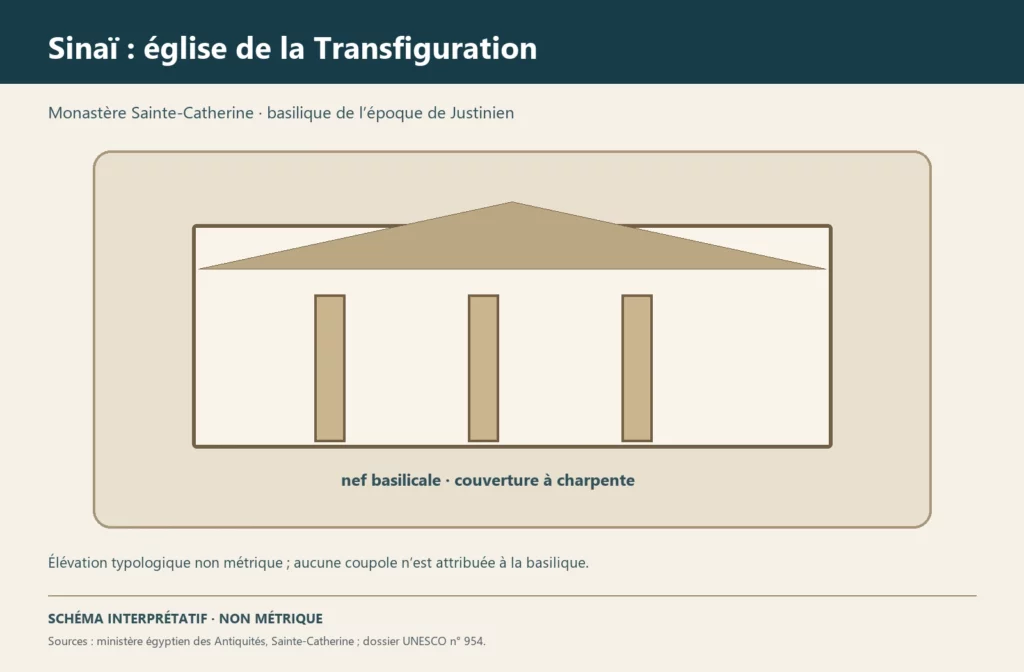
The fortified monastery was built on the orders of the Byzantine emperor Justinian I (527–565) to house the monks who had settled in the peninsula since the 4th century. The date of the main church is given by its roof beams, whose inscriptions honour Justinian and his wife Theodora: since Theodora died in 548 and Justinian in 565, the church was completed between these two dates. The Egyptian Ministry of Tourism and Antiquities adopts the range 548–565 for the construction. The patronage of St Catherine of Alexandria, a martyr of the early 4th century, is later: according to tradition, the monks found her body in the 9th century on the neighbouring mountain that now bears her name.
The church of the Transfiguration and the enclosure
The church of the Transfiguration of Christ the Saviour is the major building of the enclosure; it includes several chapels, among them that of the Burning Bush, placed where, according to tradition, God spoke to Moses. The apse, above the high altar, preserves the mosaic of the Transfiguration, one of the principal monuments of early Byzantine art. The enclosure also contains other churches, the monks’ quarters, a refectory, an olive press, ossuaries and a Fatimid mosque of the 12th century. The library holds rare books and some 6,000 manuscripts.
The expeditions of 1956–1965
The modern scientific study of the architecture and decoration owes much to the joint expeditions of the universities of Michigan, Princeton and Alexandria: a reconnaissance in 1956, then seasons in 1958, 1960, 1963 and 1965, under the direction of George H. Forsyth Jr., with Kurt Weitzmann (Princeton) and Ahmed Fikry (Alexandria). Unable to excavate, for religious reasons, the researchers confined themselves to describing, surveying and photographing the buildings and original works. They found that the tesserae of the apse mosaic were coming away from the vault; restorers from Istanbul carried out an emergency consolidation.
The Codex Sinaiticus, a dispersed manuscript
Between 24 May and 1 June 1844, the monks showed the German scholar Constantin Tischendorf 129 leaves of the Old Testament of this Greek manuscript of the Bible, copied more than sixteen centuries ago; he obtained 43 of them, which entered Leipzig University Library. On his third visit, in 1859, under the patronage of Tsar Alexander II, he saw on 4 February 347 leaves, handed over to the tsar in 1862 with his facsimile edition. The Soviet government sold them to the British Museum for 100,000 pounds; they arrived in London on 26 December 1933. On 26 May 1975, the clearing of a room beneath the chapel of St George, against the north wall, revealed a cache of manuscript fragments including at least eighteen leaves or fragments of the Codex.
A monument still lived in
The Codex is now shared between the British Library, Leipzig University Library, the National Library of Russia and the monastery. The absence of excavation limits knowledge of the phases before Justinian and of the development of the enclosure, whose buildings in use have been continuously maintained and altered.
Sources
Main sources (consulted on 30 September 2026): Saint Catherine’s Monastery, Egyptian Ministry of Tourism and Antiquities; Monastery of St. Catherine at Mount Sinai, Egypt, Kelsey Museum of Archaeology, University of Michigan; History of Codex Sinaiticus, Codex Sinaiticus Project (British Library, Leipzig, National Library of Russia, Saint Catherine’s Monastery).