Identification and location
Tod, ancient Djerty, is one of the cult centres of Montu in the Theban region. The Institut français d’archéologie orientale (IFAO, French Institute of Oriental Archaeology) places the first remains securely attributed to a temple under Mentuhotep II, around the beginning of the Middle Kingdom; interventions followed under Mentuhotep III. A pillar bearing the name of Userkaf and a few reliefs thought to be older are not enough to prove the existence at Tod of an Old Kingdom sanctuary, since the pillar names neither Tod nor Montu. The chronology must therefore distinguish the presence of objects from the demonstrated existence of a building. After rare traces from the reign of Amenemhat I, Senusret I had a new temple built. Part of its façade, many scattered fragments and elements of granite door jambs remain. The façade received a long inscription that combines a royal speech with praise of the courtiers and refers to the troubles that followed the death of Amenemhat I. This text is an elaborate political and religious statement. It must be read with its architectural context and compared with other sources before being used as a factual account of the events.
General presentation
The inscription mentions certain fittings of the new building, but these terms do not always correspond to a room that can be located. Elements of gold-plated wood, a quay or masts belong to the vocabulary of royal foundation; the correspondence with particular remains has yet to be demonstrated. A large mudbrick area identified by the excavations has been compared with the god’s ‘terrace’, but this identification remains a proposal. The preserved façade and the fragments do not make it possible to reconstruct the whole plan with certainty.
Monuments and remains
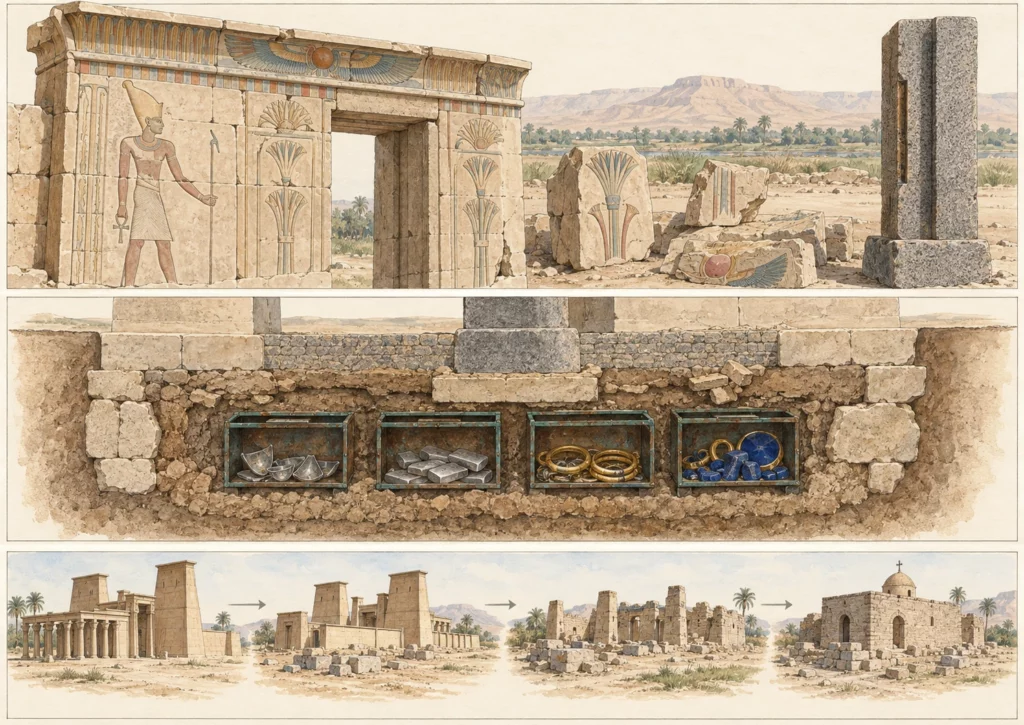
Probably under Amenemhat II, four copper chests inscribed with the king’s name were buried in the foundations. Their contents included folded silver cups, silver bars and rings, gold, raw or worked lapis lazuli and cylinder seals of Mesopotamian type. The discovery dates from February 1936; the Louvre holds a large part of this group. The royal name dates the context of the deposit and does not necessarily date the manufacture of all the objects. The variety of the materials suggests networks of exchange, without allowing a single route to be assigned to each one.
Chronology and building phases
The deposit has sometimes been presented as simply hidden wealth. Its position in the foundations rather indicates an act linked to the sanctuary, whose exact meaning is still debated. The IFAO places it in a phase later than the construction of the temple of Senusret I. The archaeological discovery must also be distinguished from the objects now dispersed among collections. A visual reconstruction with four chests side by side simplifies their context: it gives neither their exact position nor the authentic arrangement of each piece at the time of burial.
History and functions
The sanctuary later underwent transformations down to the late periods. A Christian community set up a church on the site of the temple of Senusret I and reused its stones on a large scale. This reuse altered the reading of the Middle Kingdom walls, but may also have preserved fragments in another building. The excavations and epigraphic study of the IFAO have inventoried the ancient blocks, notably during the missions of 2000 to 2007. Their records make it possible to separate, as far as possible, the original phases from the displacements.
Excavations and the history of research
The interest of Tod lies in the combination of several kinds of sources: façades and doorways, a royal inscription, architectural fragments, a buried deposit and reuse. None of them is enough on its own to reconstruct an architectural continuity without gaps. Researchers must identify the provenance and date of each block, then compare these data with the stratigraphic contexts. Absolute dates for the Middle Kingdom vary between chronologies; dynastic attributions and inscribed names offer more direct reference points than automatically assigning a precise year to each stone.
State of preservation and research questions
On site, one sees mainly the limestone façade of the temple of Senusret I. Beside the dromos stands the barque shrine of Thutmose III, restored under the Ramesside kings. Two sandstone vestibules were added in the Ptolemaic and Roman periods; they are decorated with the names of Ptolemy VIII to Cleopatra VII, then of Antoninus Pius. Around them lie hundreds of blocks, most of them cleared by Fernand Bisson de la Roque, and the remains of the church that absorbed part of the temple’s stones. The modern village surrounds the site.
The IFAO fieldwork ended in January 2007; the edition of the inscriptions of the Ptolemaic and Roman temple has been complete since 2003. The scattered blocks remain to be published, those from the Middle Kingdom to the 17th Dynasty on the one hand, those of the Ptolemaic and Roman periods on the other, from the facsimiles made to scale. Two questions remain open: the existence of a sanctuary earlier than the 11th Dynasty, which the pillar of Userkaf is not enough to establish, and the exact provenance of the materials of the treasure, cautiously linked to the Aegean world, Anatolia and the Near East.
Sources
Main sources: IFAO, ‘Tôd : temple de Montou au sud de Thèbes’, https://www.ifao.egnet.net/uploads/docs/sites/IFAO-tod_2008.pdf (in French); IFAO, ‘L’inscription de Sésostris Ier à Tôd’, https://www.ifao.egnet.net/bifao/091/01 (in French); Musée du Louvre, ‘Trésor de Tôd’ record, https://collections.louvre.fr/ark:/53355/cl010462441 (in French); IFAO, Tod site page, https://www.ifao.egnet.net/archeologie/tod/ (in French) (consulted on 27 September 2026).