Identification and location
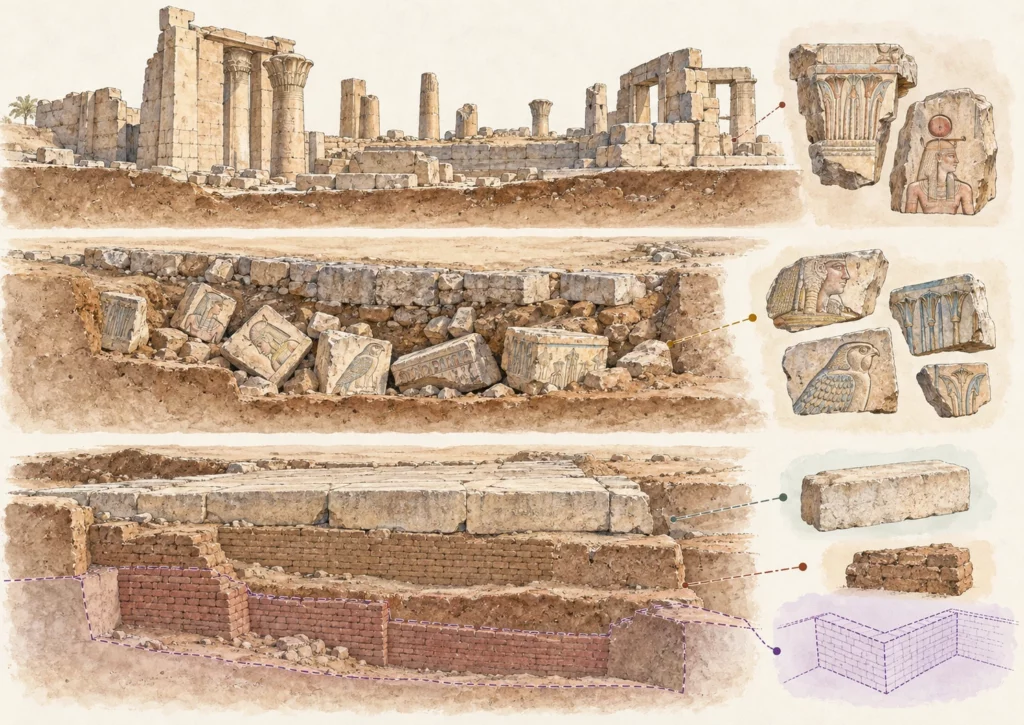
Medamud, ancient Madu, lies north of Karnak. Its temple was dedicated to Montu, a major deity of the Theban region. The accessible ruins are mainly those of a Ptolemaic and Roman temple, built by transforming an older building. The Institut français d’archéologie orientale (IFAO, French Institute of Oriental Archaeology) stresses that the archaeological site extends far beyond the temenos alone: the ancient kom covers about fifteen hectares and includes urban areas long little studied. The chronology of the sanctuary must therefore be deduced from the masonry, the objects, the inscriptions and the history of the quarter together. The IFAO campaigns of the 1920s and 1930s cleared the temple and its foundations. Fernand Bisson de la Roque found there hundreds of decorated blocks of the 12th and 13th Dynasties, reused in a foundation raft attributed to Thutmose III. These fragments prove the existence of earlier monuments and preserve part of their figurative programme. Their position in a later fill is not, however, their original location. Associating them directly with a particular wall of the temple of Senusret III would require further arguments.
General presentation
At the back of the temple, the excavators identified a platform of uninscribed limestone corresponding to the sanctuary established under Senusret III. Clément Robichon, after 1933, studied the foundations and recognised brick levels linked to this platform, useful for understanding the outline of the building. Reconstructions of its plan have changed with the discoveries. The existence of a great Middle Kingdom programme can be accepted, without transferring to the vanished ground all the walls or decoration known from reused fragments.
Monuments and remains
An older brick enclosure or structure was called the ‘primitive temple’ by the first excavators. Its identification has been discussed, notably because its forms and stratigraphic relationships were interpreted differently in the 20th century. Félix Relats Montserrat has returned to the archives of the 1938–1939 excavations to re-examine this controversial building. A historical excavation label should not therefore be presented as proof of a dated and fully known temple.
Chronology and building phases
Montu was honoured in several centres of the Theban region. At Medamud, his sanctuary was rebuilt through the dynasties and remained important under the Lagids and the Roman emperors. It would be misleading to consider all the parts of the site as contemporary. The decorated stones of the Middle Kingdom, the raft of Thutmose III and the late walls represent different episodes. The successive reconstructions bear witness to the long duration of the cult, but they also displaced the evidence for its early phases.
History and functions
The present IFAO mission is taking up the data of the earlier excavators and exploring the little-studied areas of the kom. Its objectives include the history of the enclosures, the Middle Kingdom remains, the craft production quarters and the conservation of the site. This approach makes it possible to place the sanctuary back in its urban setting. It also corrects hypotheses established on a small area cleared at the beginning of the 20th century. Published results must be distinguished from questions still under study.
Excavations and the history of research
The blocks kept in the museums of Cairo and the Louvre each require their own provenance record and date. Some come from reused foundations, others from different areas. Their modern distribution does not make it possible simply to redraw the ancient walls. Likewise, a late gateway visible on the site cannot be attributed to Senusret III by proximity. The plans of the platform, the records of the brickwork and the documentation of the blocks are the preferred basis for any detailed analysis of the architectural programme.
State of preservation and research questions
The visible temple is that of the Ptolemaic and Roman periods. It faces two main threats: rising groundwater, linked to the intensification of farming in the Theban region, which loads the stone with salts, and the cement of the restorations of the early 20th century, still embedded in many blocks, which accelerates their decay. The Gate of Tiberius, which probably collapsed in the 18th century, now survives only as blocks, photographed, partly restored and protected on benches. Since 2011, an IFAO restoration programme has been removing the old cement and consolidating the masonry.
Scientifically, the excavation remains largely open: three quarters of the kom, which covers about fifteen hectares, have not been explored. Since 2015, clearances guided by geomagnetic survey have uncovered two potters’ workshops of the 25th Dynasty and an older area of kilns, from the beginning of the New Kingdom. The mission directed by Félix Relats Montserrat seeks to date the enclosures, to find the mudbrick buildings of the Middle Kingdom and to understand how the temple fitted into the town. A new edition of the temple inscriptions and a study of the decoration of the Gate of Tiberius are also under way.
Sources
Main sources: IFAO, ‘Médamoud : un temple thébain de Montou et ses quartiers artisanaux’, https://www.ifao.egnet.net/recherche/archeologie/medamoud/ (in French); Félix Relats Montserrat, ‘Les fouilles du “temple primitif” de Médamoud (1938–1939)’, https://www.ifao.egnet.net/uploads/publications/enligne/BIGEN071_art_04.pdf (in French); IFAO, scientific operation 17144, https://www.ifao.egnet.net/recherche/operations/op17144/ (in French); UCL, ‘Senusret III’, https://www.ucl.ac.uk/museums-static/digitalegypt/chronology/senusretIII.html (consulted on 27 September 2026).