In brief
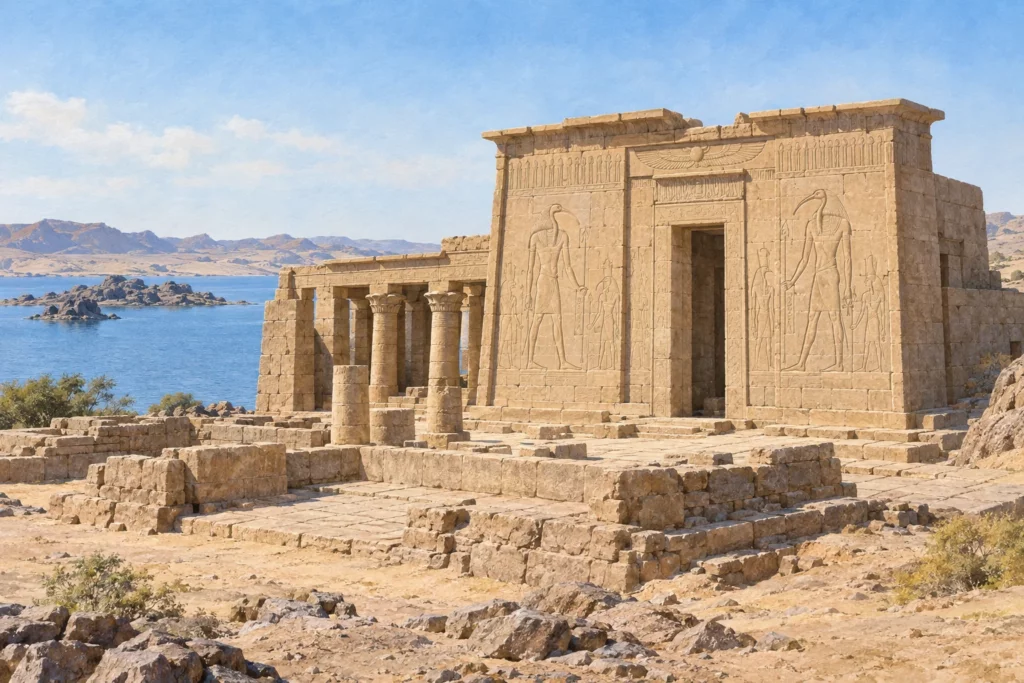
The temple of Dakka, ancient Pselkis, stood on the west bank of the Nile, in Lower Nubia, and honoured Thoth of Pnubs, a god whose name refers to a place much further south, near Kerma, at the level of the Third Cataract. Its early core is a small chapel decorated under the Meroitic king Ergamenes II, also called Arqamani. The Ptolemaic sovereigns, then Augustus, enlarged and decorated it in their turn. The monument was dismantled and rebuilt at Wadi es-Sebua between 1962 and 1968, during the international campaign to save the monuments of Nubia.
What you discover
The temple follows a north–south axis, parallel to the river. One first approaches the pylon, 24.31 metres wide and 11.62 metres high, whose surface was largely left undecorated. A causeway about 55 metres long and 5 wide preceded the building; it contained reused New Kingdom blocks, proof that older stones had served the work. Behind the gate, the pronaos stands out for its two columns on the façade and the absence of supports inside: the architraves are more than six metres long. Further on, the original single-room chapel measures only 5 metres by 6.8, with a cavetto cornice, and the Roman sanctuary houses a red granite naos.
Its history
The building phases can be read by sovereign. Ptolemy IV Philopator (221–205 BC) had the gate and a large hall built, decorated with his epithet ‘he who loves his father’. Ergamenes II (c. 218–190 BC) decorated the single-room chapel and confirmed the decree of the Dodecaschoenus, the frontier province extending south of Aswan. Ptolemy VIII Euergetes II adorned the façade of the pronaos. Augustus added the Roman sanctuary and decorated the inner walls of the pronaos; Tiberius had the lintel of the entrance redecorated. The temple was recorded and published by Roeder, who worked there in 1910, with volumes issued in 1913 and 1930. The move of the 1960s saved the whole from the rising waters, but it placed the temple in a landscape that is no longer its own.
What to look at
The back wall bears a monumental false door, 2.53 metres by 4; a later entrance was cut through it to reach the naos. This opening alone shows that the temple was altered after it was designed. On the walls, more than a hundred Greek and Latin graffiti, recorded by Ruppel in 1930, and some ninety Demotic graffiti recall the pilgrims who came here. On the west tower of the pylon, a graffito in Meroitic cursive, dated to the 1st century BC, signals the presence of visitors from the south. The exact origin of each graffito and the share of Nubian patrons in the choices of decoration remain partly debated.
Sources
Consulted on 30 September 2026: El-Dakka (Pselchis), UCLA Encyclopedia of Egyptology; Temples of Wadi es-Sebua, Egyptian Ministry of Tourism and Antiquities; Nubian Monuments from Abu Simbel to Philae, UNESCO.