Identification and location
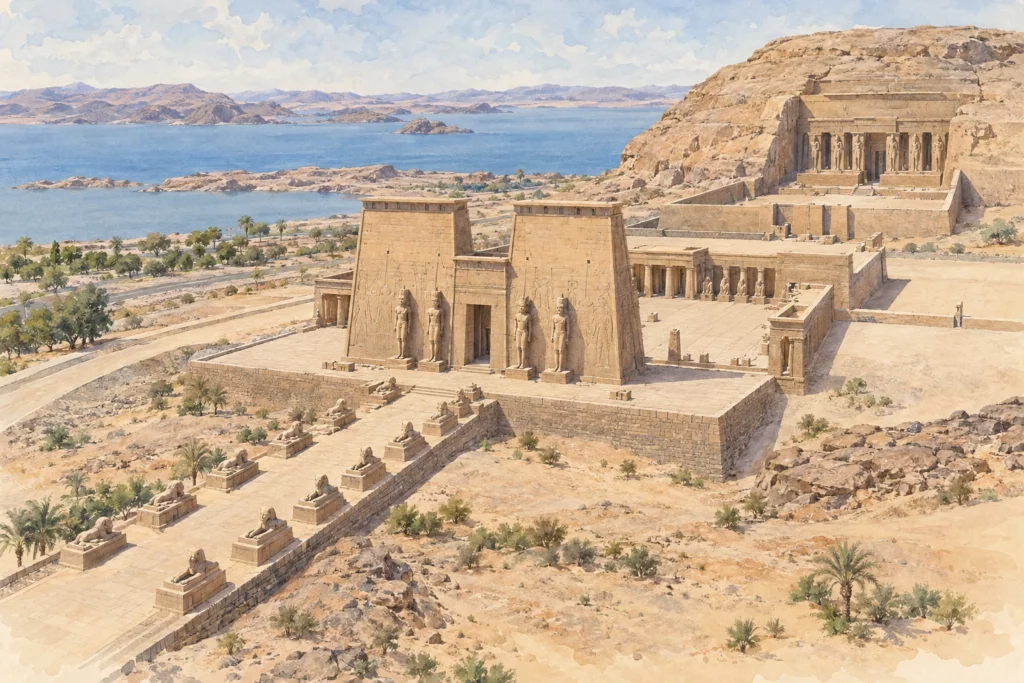
Wadi es-Sebua, the ‘valley of the lions’, owes its Arabic name to the avenue of sphinxes in front of the temple of Ramses II (Ramesses II). The site lay on the west bank of the Nile, in Lower Nubia. Threatened by Lake Nasser, the temple was moved in the 1960s about 4 km north-west of its original location, to the site known as New Sebua, where it stands near the temples of Dakka and El-Maharraqa.
Architecture and decoration
The temple is a hemispeos: its front part is built of blocks, its rear part cut into the rock. An avenue of human-headed and falcon-headed sphinxes leads to a sandstone pylon, then to a court lined with pillars in front of which stood statues of the king. The rooms cut into the cliff lead to the sanctuary.
The Egyptian ministry states that the temple was dedicated to Amun-Ra and Ra-Horakhty. As in other Nubian temples of the reign, Ramses II also appears there in deified form.
Chronology and functions
The temple belongs to the series of sanctuaries that Ramses II had built in Nubia. Its construction is attributed to the action of Setau, viceroy of Kush, in the second half of the reign. The monument served the cult of the gods of the state and of the king, while marking the Egyptian presence along the river.
In the Christian period, the rock-cut part was turned into a church. Paintings then covered part of the pharaonic reliefs; in the sanctuary, the fall of a layer of plaster reveals Ramses II presenting an offering to a saint, identified as St Peter. This layering bears witness to the long reuse of the place.
The rescue
The move was carried out as part of UNESCO’s international campaign. The built part was dismantled and rebuilt, and the rock-cut part was cut out. The new site groups monuments that were not neighbours in Antiquity: their present proximity is the result of the rescue.
State of preservation and research questions
The sphinxes, the statues of the court and the reliefs are unevenly preserved. Comparing the records made before the move, old photographs and the present state makes it possible to distinguish what belongs to the ancient monument from what belongs to the reconstruction. The Christian reuse offers a case study in the transformation of Nubian temples into churches.
Sources
Main sources (consulted on 28 September 2026): Egyptian ministry, temples of Wadi es-Sebua; UNESCO, Nubian Monuments from Abu Simbel to Philae; UNESCO, International Campaign to Save the Monuments of Nubia.