Identification and location
El-Maharraqa is a small temple of the Roman period, dedicated according to the Egyptian Ministry of Tourism and Antiquities to the couple formed by Isis and Serapis. It stood in Lower Nubia, probably in the region known as the Dodecaschoenus, the frontier province of Ptolemaic and then Roman Egypt. The UCLA Encyclopedia of Egyptology defines it as the southern province between Aswan and the Wadi Allaqi, over twelve schoenoi, about seventy-five miles. Following the building of the High Dam, the temple was dismantled and then rebuilt at New Sebua, about four kilometres north-west of the original site of Wadi es-Sebua, with the temple of Ramses II (Ramesses II) and that of Dakka.
A monument of the Roman period
The Roman dating of the temple is given by the Egyptian ministry, and UNESCO lists the temple among the monuments of Nubia saved from the rising waters. The sources consulted provide neither the precise date of foundation nor the name of the emperor under whom work began. Any attribution to a particular reign therefore remains, on the present documentation, a hypothesis. The history of this temple should also be distinguished from that of its neighbour Dakka, whose Ptolemaic, Meroitic and Roman phases are well documented by Roeder and later publications.
Organisation of the site and decoration
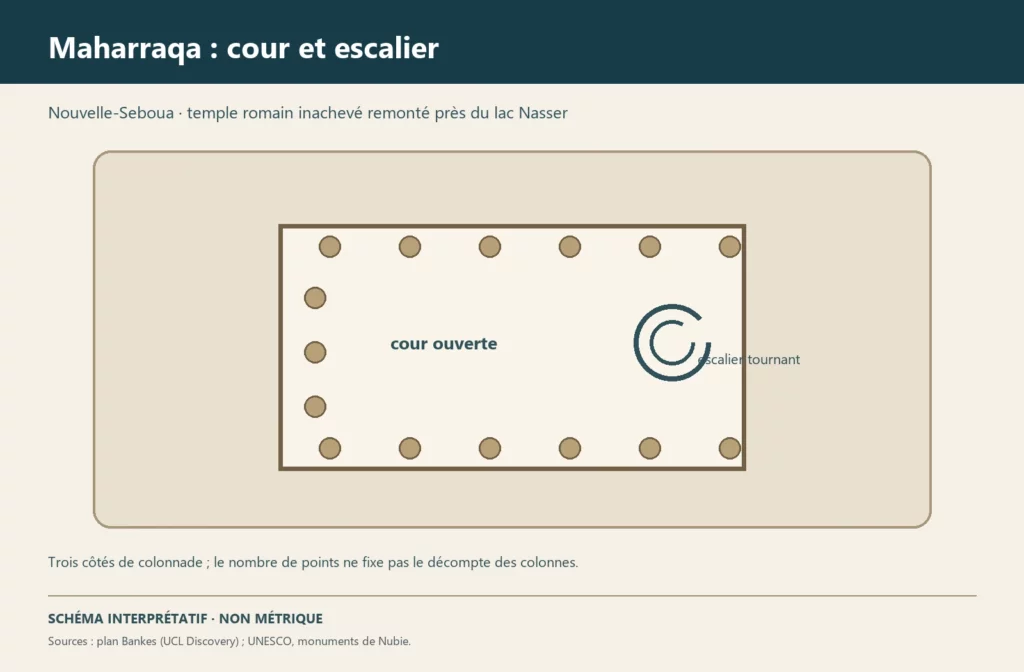
The description of the monument in the sources consulted remains brief: the ministry gives its dedication and date, but not its plan. The idea of an unfinished building, often associated with El-Maharraqa, therefore needs to be checked against the archaeological records, in particular those made before dismantling. Without these documents, it would be unwise to describe specific rooms, columns or decoration here. The case is useful for method: a temple whose plan is incomplete should not be completed from parallels, and the gap must be kept between what was built, what was decorated and what has been imagined by modern reconstructions.
The rescue and reconstruction
The International Campaign to Save the Monuments of Nubia lasted from 1960 to 1980. According to UNESCO, the temples of Dakka, El-Maharraqa and Wadi es-Sebua were dismantled and then rebuilt as a single group, near the old site of Wadi es-Sebua. The rescued temples are among the ten components of a property covering 374.48 hectares in the Aswan region, inscribed on the World Heritage List in 1979. The grouping saved the masonry, but it now brings together buildings that were not neighbours in Antiquity and changes their relationship with the landscape. The replaced blocks may show modern joints; the archives of the work are essential for distinguishing ancient from restored.
Open questions
Several points remain to be documented: the reign of foundation, the reasons for the possible interruption of the work, the place of the cult of Isis and Serapis in local practice, and the exact state of the monument before its transfer. A synthetic publication based on the rescue records would make it possible to answer these questions and to correct descriptions repeated without verification in popular literature.
Sources
Main sources (consulted on 30 September 2026): Temples of Wadi es-Sebua, Egyptian Ministry of Tourism and Antiquities; Nubian Monuments from Abu Simbel to Philae, UNESCO; The Rescue of Nubian Monuments and Sites, UNESCO; Philae, UCLA Encyclopedia of Egyptology.