Identification and location
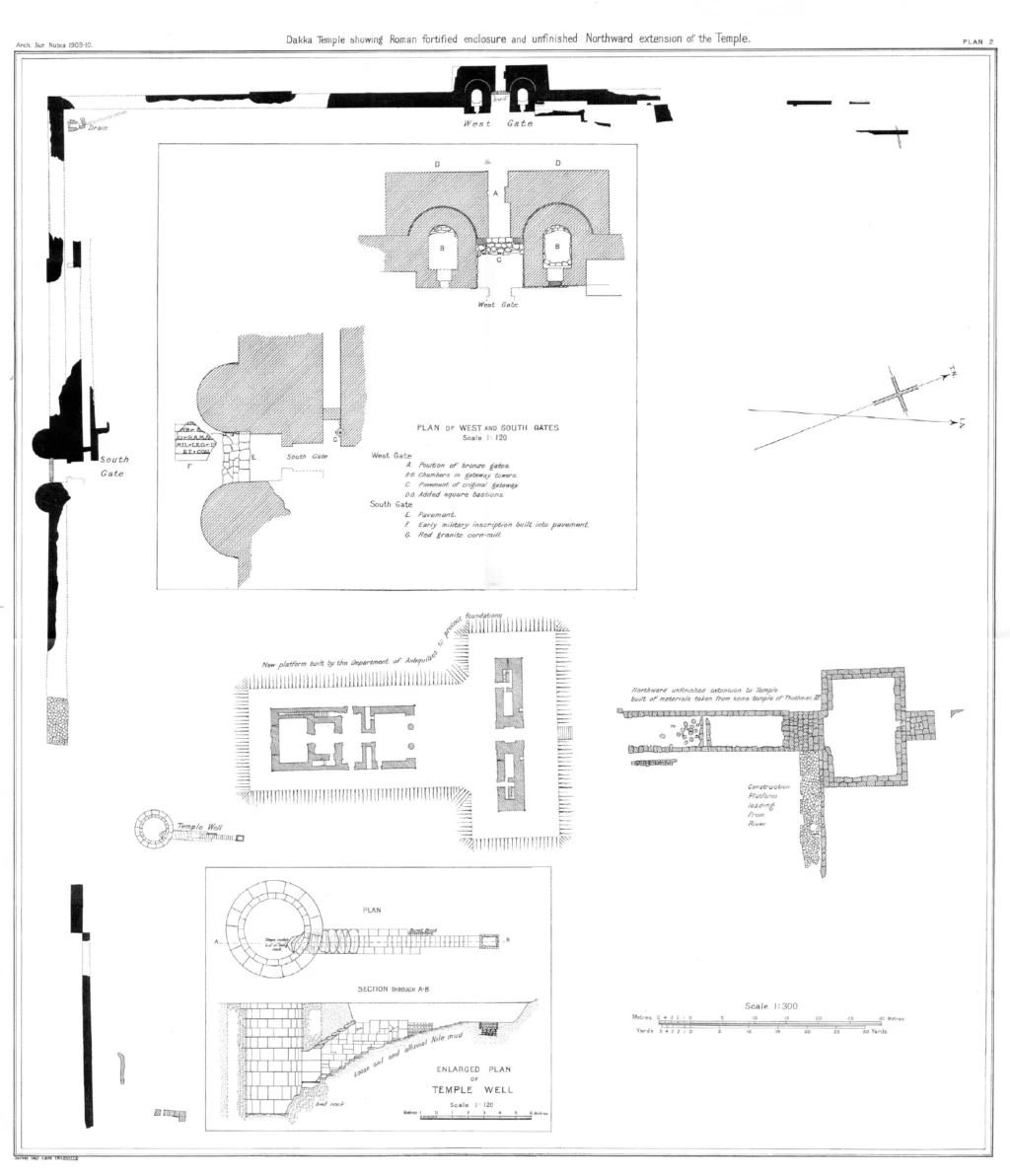
The temple of Dakka, ancient Pselkis, was dedicated to Thoth of Pnubs. It stood on the west bank of the Nile, in Lower Nubia, in the region of the Dodecaschoenus, the strip of territory south of Aswan disputed by the Ptolemies and the kings of Meroe. It was moved in the 1960s to the site of New Sebua, near the temple of Ramses II (Ramesses II) at Wadi es-Sebua.
Architecture and decoration
The temple follows a classic axial plan: a pylon, a court, a pronaos, an intermediate hall and a sanctuary. The pylon, well preserved, has inner staircases leading to its top. The reliefs show the sovereigns making offerings to Thoth and other deities, following the conventions of Egyptian temple decoration.
Chronology and building phases
The core of the temple is attributed to the Meroitic king Arqamani, in the second half of the 3rd century BC, a contemporary of Ptolemy IV, whose name also appears in the decoration. The monument was enlarged in the Ptolemaic period and then in the Roman period, notably under Augustus. This succession of patrons, Egyptian, Meroitic and Roman, makes Dakka a witness to the rivalries and exchanges in this frontier zone.
Reading the cartouches makes it possible to distinguish the campaigns of building and decoration. A single wall may have been built by one sovereign and decorated later by another.
History and functions
Thoth, god of writing and knowledge, was honoured at Pselkis in a local form. The temple was part of a network of Nubian sanctuaries frequented in the Graeco-Roman period. Nearby stood a Roman fortress that controlled the route to the gold mines of the Eastern Desert.
State of preservation and research questions
The move preserved most of the masonry but changed the context of the monument. Current research focuses on the relations between Meroe and Ptolemaic Egypt, on which Dakka sheds light through the joint presence of kings of both kingdoms in the decoration.
Sources
Main sources (consulted on 28 September 2026): Egyptian ministry, temples of Wadi es-Sebua; UNESCO, Nubian Monuments from Abu Simbel to Philae; UNESCO, International Campaign to Save the Monuments of Nubia; UCLA Encyclopedia of Egyptology (UEE), reference entry.