Identification and location
The temple of Amada is a New Kingdom sanctuary originally built in Egyptian Nubia, then transferred to New Amada during the rescue of the monuments threatened by Lake Nasser. The reconstruction site also holds the temple of el-Derr and the tomb of Pennut, separate monuments that should not be confused with Amada. According to the Egyptian ministry, the present temple lies about 2.5 kilometres from its old location. The place visited today therefore preserves an ancient building in a modern landscape that differs from its original context.
General presentation
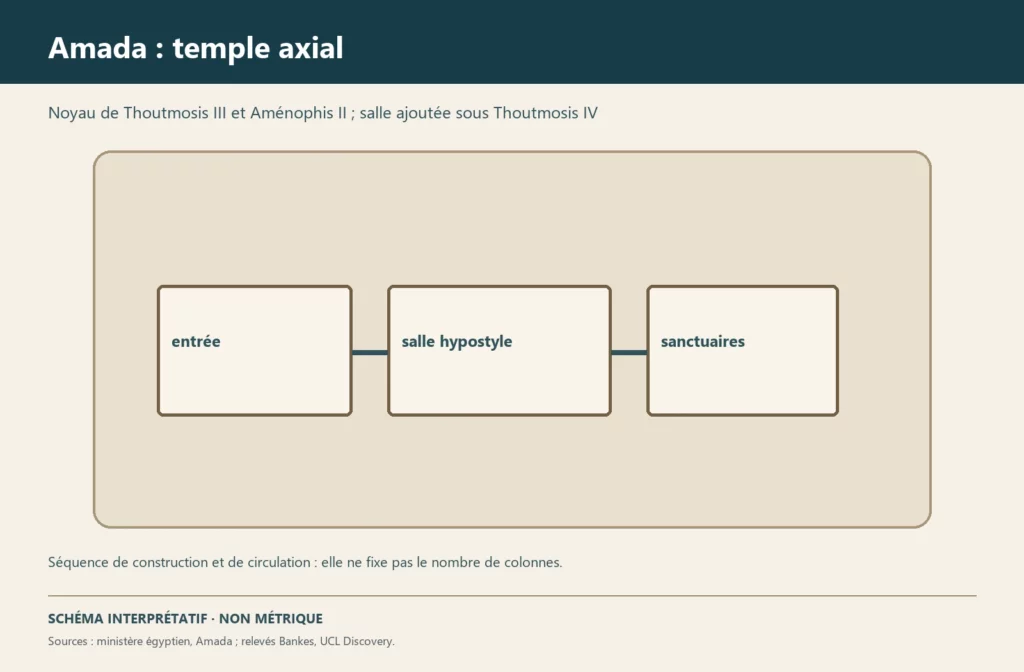
Amada is one of the oldest temples preserved in the Lake Nasser region. The core was built under Thutmose III and Amenhotep II, in the 18th Dynasty. Thutmose IV added a hypostyle hall in front of the older spaces; modifications followed in the 19th Dynasty. This succession of reigns explains why the building cannot be attributed to a single patron. The plan reads along an axis of rooms and passages towards the sanctuary, with an added front section.
Monuments and remains
The reliefs show the king performing rites before Amun-Ra and Ra-Horakhty, the two deities to whom the temple was dedicated. Alongside these scenes, the inscriptions provide other historical information. Amenhotep II had an account of a campaign in Asia carved on the back wall of the sanctuary; an inscription of Merneptah appears on the left thickness of a doorway. These texts belong to different moments in the history of the temple. The paintings and reliefs are remarkably well preserved partly because a layer of plaster covered them when the building was turned into a church. This protection changed the appearance of the walls while preserving ancient surfaces.
Chronology and building phases
The first rooms belong to the middle of the 18th Dynasty, under Thutmose III and Amenhotep II. The hypostyle hall of Thutmose IV forms a later extension. Interventions under the 19th Dynasty include in particular the inscription of Merneptah. The Christian conversion is another phase of use, recognisable by the plaster that covered the decoration. Finally, the move in the 1960s responded to the building of the Aswan High Dam. One must therefore distinguish the date of the reliefs, that of the religious transformations and that of the reconstruction: none of these episodes on its own describes the present building.
History and functions
The sanctuary served the cult of Amun-Ra and Ra-Horakhty in Nubia. The scenes presenting the sovereign to these gods link the local rite to New Kingdom kingship. The campaign inscriptions also associate the monument with the representation of military power, without turning the whole temple into a historical chronicle. Its reuse as a church bears witness to continuity of occupation and to a profound change in cult practice. Since the rescue, the function of the building has been one of heritage: its preservation at New Amada does not mean that the orientation, the surroundings and the other nearby monuments exactly reproduce the ancient site.
Excavations and the history of research
The inscriptions and reliefs of Amada were copied and studied before the Nubian rescue, which makes it possible to compare the earlier state with the reconstruction. The international campaign linked to the High Dam grouped several monuments at New Amada to avoid their submersion. The Egyptian ministry explicitly distinguishes the temple of Amada, that of el-Derr and the tomb of Pennut on the present site. To study the building phases, surveys of the masonry and decoration are more reliable than an overall image. Comparisons must specify whether they concern the original location, the state before transfer or the restored presentation of today.
State of preservation and research questions
The relatively well-preserved decoration does not mean that all the layers and all the spaces are intact. The plaster of the Christian phase, the dismantling, the restorations and the joints of the reconstruction belong to the material history of the temple. Research questions concern the exact sequence of the building campaigns, the reading of the inscriptions and the effect of the move on our understanding of the cult landscape. A map must show the old site of Amada and New Amada separately; a plan of the building must distinguish the 18th-Dynasty core from later additions. The reader should not take an educational reconstruction for a metric excavation survey.
Sources
Main sources: Egyptian Ministry of Tourism and Antiquities, ‘Amada Temple’ and ‘Amada Temples’, pages consulted on 28 September 2026: https://egymonuments.gov.eg/monuments/amada-temple/; https://egymonuments.gov.eg/archaeological-sites/amada-temples/. The distinction between the original site and the place of reconstruction follows these official descriptions.