Identification and location
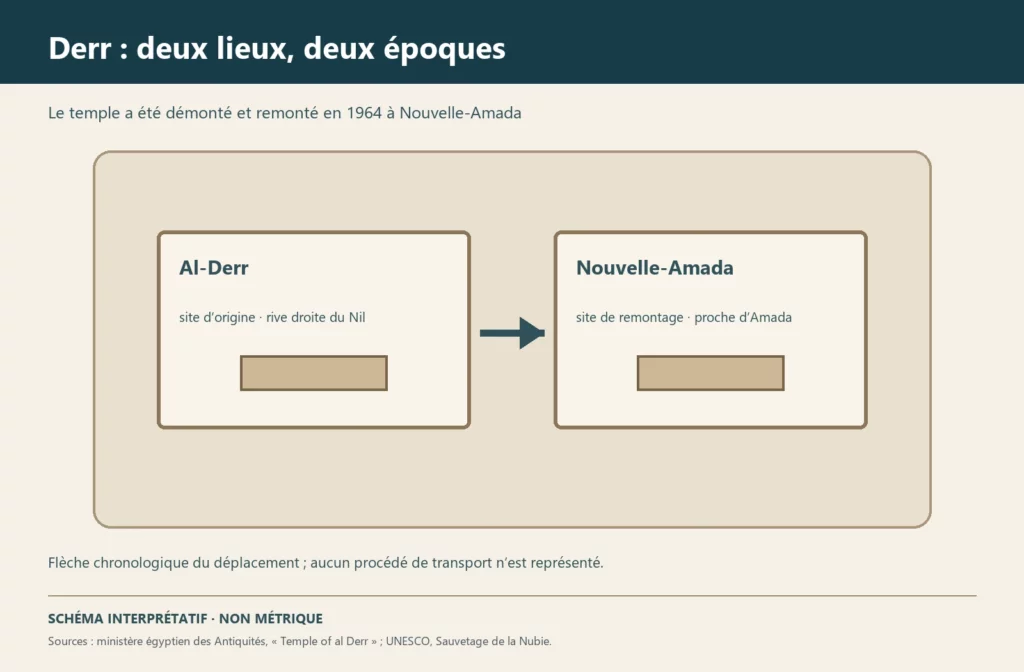
The temple of el-Derr is a rock-cut temple of Ramses II (Ramesses II), originally cut into a cliff in Lower Nubia. Its ancient name, according to the Egyptian ministry, was ‘the temple of Ramses beloved of Amun in the domain of Ra’. In 1964 it was dismantled and transferred to escape the waters of Lake Nasser; it now stands near the temple of Amada, on the site of New Amada.
Architecture and decoration
The temple comprises two successive pillared halls leading to a sanctuary. In the niche of the sanctuary, four statues cut from the rock represent Ptah, Ra-Horakhty, the deified Ramses II and Amun-Ra. This arrangement recalls that of the great temple of Abu Simbel, on a more modest scale.
The first hall bears scenes of the king’s military campaigns. Most of the other reliefs show Ramses II performing rites before the gods. The Egyptian ministry stresses the very good preservation of the colours in the second pillared hall.
Chronology and functions
The temple dates from the 19th Dynasty, under Ramses II (c. 1279–1213 BC). Like the other Nubian sanctuaries of the reign, it combines the cult of the gods of the state with that of the deified king. It was later turned into a church, like several temples in Nubia.
The rescue
The move of 1964 made it possible to preserve the decoration, but it broke the link between the temple and its original cliff. Its present proximity to Amada, a temple of the 18th Dynasty, results from the modern grouping of the rescued monuments.
State of preservation and research questions
The colours of the second hall are a precious testimony to Ramesside polychromy. Comparison with Abu Simbel, Wadi es-Sebua and Gerf Hussein makes it possible to study the series of Nubian temples of Ramses II, while taking account of local differences in plan and decoration.
Sources
Main sources (consulted on 28 September 2026): Egyptian ministry, temple of al-Derr; UNESCO, Nubian Monuments from Abu Simbel to Philae; UNESCO, International Campaign to Save the Monuments of Nubia.