Identification and location
The temple of Hibis lies in the Kharga Oasis, the largest in the Western Desert, about 200 kilometres west of the Nile Valley. It rises just north of the modern town of El-Kharga. The sanctuary was dedicated to Amun, ‘lord of Hibis’; Mut, Khonsu, Osiris and Horus were also worshipped there.
From the Saites to Nectanebo II: a disputed chronology
The foundation and construction are traditionally attributed to Darius I (521–486 BC), whose name appears many times in the oldest part of the temple. Some researchers take the work back to Psamtik II (595–589 BC), but the evidence is not decisive, since royal names may have been reused to confer legitimacy. According to Christiane Zivie-Coche, construction may have begun under the 26th Dynasty, the temple having been built mainly under the 27th Dynasty, decorated chiefly in the name of Darius and completed under Nectanebo II. The theory of Eugene Cruz-Uribe (1987), which attributed most of the work to the Saite kings and Darius II, is considered highly speculative by David Klotz, for whom the phase of decoration sometimes dated to Darius II is not confirmed by the epigraphy.
A traditional plan extended eastwards
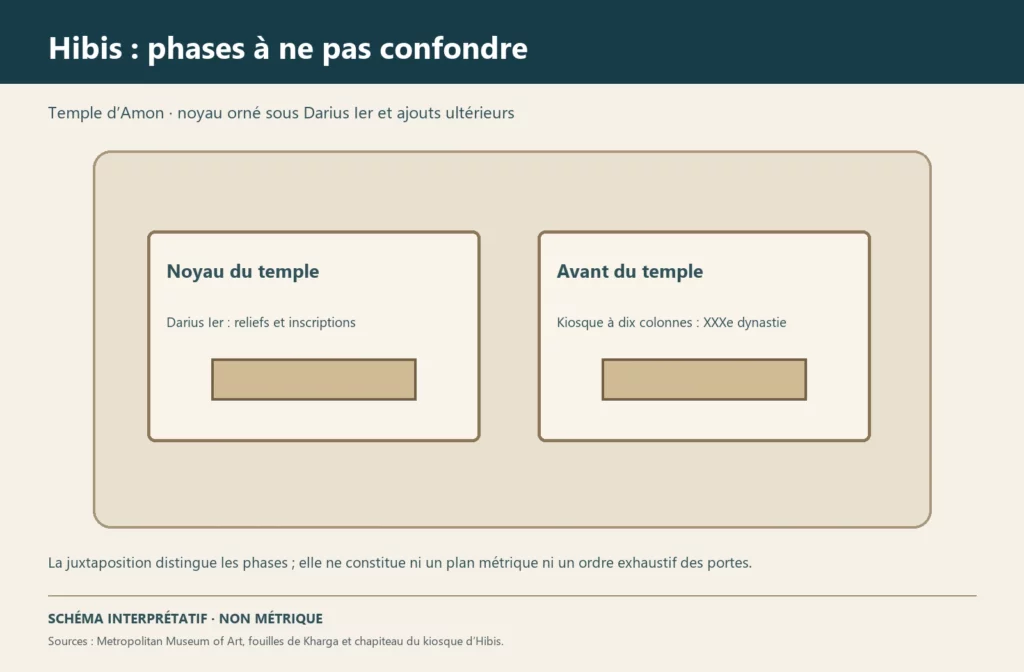
The original core comprised a forecourt, a hypostyle hall, the sanctuary, several small rooms and, on the upper floor, chapels reached by staircases. A second, larger hypostyle hall and a portico were added in front of the entrance, on the east side, as were an enclosure wall and pylons. The plan follows the model of the traditional Egyptian temple, with several particular arrangements.
The naos of the seven hundred gods
The walls of the naos bear nine registers with a succession of some 700 representations of gods, or perhaps of divine statues, ordered by region: a cultic and topographical panorama of Egypt, in which each nome takes a form of Osiris. The sanctuary combines on one side an adaptation of Theban theology and, on the other, several rooms devoted to Osiris. The walls of the hypostyle hall are treated as an immense papyrus scroll, with vignettes and a series of hymns to Amun. Darius I appears there in the traditional attitudes of the pharaoh, as in the small neighbouring temple of Qasr el-Ghueita.
The edict of Tiberius Julius Alexander
On the north jamb of the outer gate is carved in Greek the edict of the prefect of Egypt Tiberius Julius Alexander, dated 6 July AD 68. At the beginning of the reign of Galba, the prefect promises in it the end of the fiscal extortion of Nero’s time and announces measures concerning taxes, property and justice. It is one of the longest edicts of a provincial governor preserved in the Roman world.
The Metropolitan Museum in the oasis
Authorised by the Egyptian government in 1907 to carry out surveys and excavations at Kharga, the Metropolitan Museum of Art conducted seasons there until the early 1930s, at the temple of Amun as in the necropolis of Bagawat. The publication, under the title The Temple of Hibis in El Khārgeh Oasis, includes notably the volume on the excavations by Herbert E. Winlock (1941) and that on the decoration by Norman de Garis Davies (1953), as well as a volume devoted to the Greek inscriptions. The facsimiles painted by Charles K. Wilkinson, kept in the museum, remain essential documentation. The temple, long studied, has undergone a major restoration and is open to the public again; it is mentioned in the dossier Kharga Oasis and the Small Southern Oases placed by Egypt on the UNESCO Tentative List in 2015.
Sources
Main sources (consulted on 30 September 2026): Henry P. Colburn, ‘Kharga Oasis’, Encyclopaedia Iranica, 2017; David Klotz, ‘Persian Period’, UCLA Encyclopedia of Egyptology, 2015; Edict of Tiberius Julius Alexander on Egypt and Galba, Judaism and Rome.