Identification and location
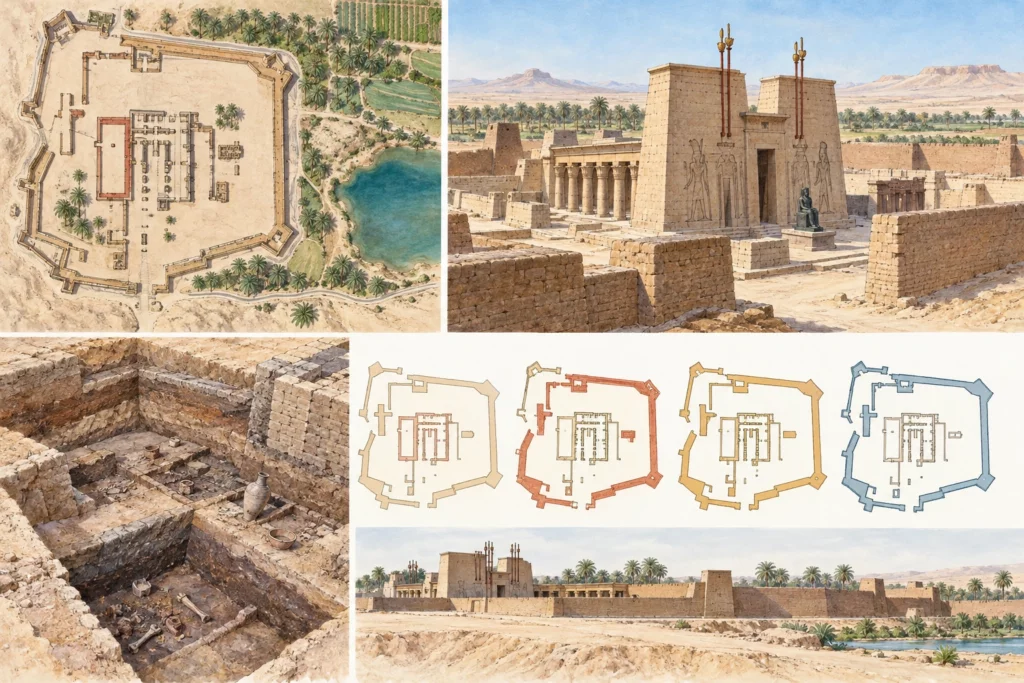
The site of Dush, Egyptian Kesh and Greek Kysis, occupies a natural sandstone mound at the southern end of the Kharga Oasis, in the Egyptian Western Desert. In the Roman period, Kysis was a kome, a village that was the chief place of a toparchy of the nome of Hibis. The settlement covered about nine to ten hectares; it combined two large monumental complexes, a mud-brick temple and a vast fortified building, the qasr, within which stands the stone temple, as well as housing, necropolises and farmland with exceptionally well-preserved field systems.
From prehistory to the 5th century AD
The surveys of the Institut français d’archéologie orientale (IFAO, French Institute for Oriental Archaeology) have recorded 84 prehistoric sites in the region, including an Epipalaeolithic camp of the 7th millennium BC near artesian wells and Neolithic occupations of the 5th millennium. At Ayn Manawir, close by, a mud-brick temple dedicated to Osiris-iu was at the centre of a farming community irrigated by qanats in the Persian period (5th–4th century BC); its Demotic ostraca make it a group distinct from Kysis. At Dush itself, the stratigraphy places the beginning of occupation at the beginning of the Ptolemaic period, and a few Ptolemaic ostraca confirm this. The visible remains date mainly from the 2nd to the 5th century AD, the best preserved from late Antiquity. The village was abandoned around the middle of the 5th century without trace of destruction; the exhaustion of the water table through overexploitation of the soils, perhaps aggravated by a climatic oscillation, is the hypothesis put forward.
The temple of Osiris-iu and Isis
The sandstone temple is dedicated to Osiris-iu, a local form of Osiris whom the Greeks identified with Sarapis, and to Isis; the two deities are shown on the outer face of the rear wall. The god’s name is generally understood as ‘Osiris the welcome one’, but Michel Chauveau, noting that the Demotic spellings, earlier than the hieroglyphic ones, record only a simple stative, proposes ‘Osiris has come’. Built under Domitian, the temple was completed under Trajan and Hadrian; a Greek dedication carved on the lintel of the first pylon is dated 26 April AD 116. The sanctuary consists of two vaulted rooms in a row, flanked by two chapels and preceded by a hypostyle hall with four columns and a vestibule.
From the temple storerooms to a military post
Large storerooms accompanied the sanctuary; this brick building next to the temple was turned into a fortress in the late Empire. Michel Reddé dates the military presence to the last quarter of the 4th century and the first quarter of the 5th century AD, the coins indicating activity after 378. Many ostraca attest the installation of soldiers in the annexes of the temple at that time, but no earlier presence. Rather than a permanent garrison, he reconstructs temporary detachments from units in the valley, and an administrative, customs and police function. The identification of the unit with the ala I Abasgorum of the Notitia Dignitatum remains uncertain. The old reading of a fort defending the southern route is thus strongly qualified.
The gold treasure of 1989
In March 1989, the IFAO mission uncovered, in the brick building next to the temple, a series of gold objects that in all likelihood came from the treasury of the temple of Isis and Sarapis. Among them is a crown ornament showing Sarapis enthroned, worn by the priests during the liturgies. Restored as a matter of urgency on site by Michel Wuttmann, it is kept in the Egyptian Museum in Cairo and was for a time exhibited at the Institut du monde arabe in Paris; Michel Reddé published it in 1992 (Douch IV, DFIFAO 28).
Half a century of French excavations
Frédéric Cailliaud visited the site in 1818. At the end of the 19th century, clandestine excavations in the necropolis yielded the archive of the necrotaphs, Greek papyri published by Grenfell and Hunt in 1897. The IFAO opened the excavation in January 1976, at the initiative of Serge Sauneron; Michel Reddé directed the seasons of the late 1980s, published in Douch III (DFIFAO 42, 2004). The necropolises have been the subject of the volumes by Françoise Dunand and her team (tombs 1 to 92), and the Greek ostraca were published in five volumes between 1986 and 2001. From 1988, a team of geographers led by B. Bousquet studied the irrigation system and the farmland, including the artesian wells and drainage galleries. The current IFAO programme involves in particular Béatrix Midant-Reynes (CNRS) and Laurent Coulon, while a thesis by Tiphaine Dachy is revising the prehistoric periodisation using radiocarbon dates.
Sources
Main sources (consulted on 30 September 2026): Michel Reddé, ‘Le sanctuaire de Sarapis et ses annexes’, in Douch III. Kysis, DFIFAO 42, 2004, reissued by Ausonius Éditions (in French); Michel Reddé, ‘Le trésor de Douch’, Comptes rendus de l’Académie des inscriptions et belles-lettres, 1989, Persée (in French); Michel Chauveau, ‘Les archives d’un temple des oasis au temps des Perses’, BSFE 137, 1996, Persée (in French).