Identification and location
Nabta Playa is a closed basin in the southern Western Desert, about 100 km west of Abu Simbel and 30 km north of the Sudanese border. A playa is a depression that temporarily holds water after rain. The basin, about 10 × 7 km according to the study by Malville and his colleagues, includes many settlement sites and a ceremonial complex of several square kilometres. Nabta Playa should therefore not be confused with its small stone circle alone. The occupations span a long part of the Holocene; most of the large stone installations belong to the Late or Final Neolithic. No patron’s name has come down to us.
General presentation
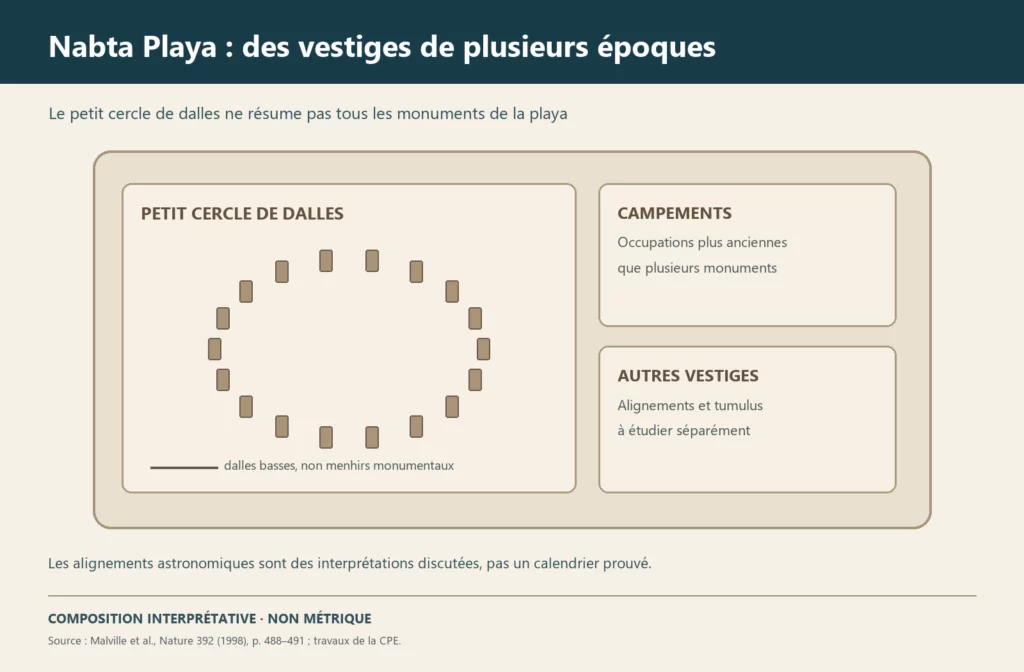
The site combines the archaeology of settlements, the history of climate and the study of monuments. The camps have yielded hearths, stone tools, pottery and animal remains; wells attest a technical response to the irregularity of water. The stone groups include alignments of stelae, complex structures, small circles and tumuli. Their distribution in the basin matters as much as the form of each remain. The term ceremonial centre is an interpretation based on this concentration of particular installations and on the associated deposits; it does not mean that all the groups were built or used at the same time.
Monuments and remains
The small circle, often called the calendar circle, is formed of relatively modest sandstone slabs. Alignments of larger blocks occupy other areas; some seem to be oriented in notable directions. In the Valley of Sacrifices, several small stone mounds have yielded cattle bones. One contained a whole cow laid in a built chamber; the others yielded more scattered remains. The excavators also described more complex stone installations, areas of stelae and many dwellings. The published plans show that these components are separate in space. A plate bringing together circle, alignment and tumulus must therefore be read as a synthesis, not as the survey of a single monument.
Chronology and building phases
The deposits of the basin record wet and dry episodes. Early camps belong to the beginning of the Holocene; Schild’s geoarchaeological study then distinguishes several phases of occupation and sedimentation, with radiocarbon dates some of which are expressed in uncalibrated years. They should not be mechanically converted into calendar dates. The cattle tumuli studied by Wendorf and Schild are placed around 7,500–7,400 years before present in calendar years, roughly the middle of the 6th millennium BC. The alignments and other megalithic constructions cover later phases, with no single date for the whole. Progressive aridification reduced the possibility of living in the basin; the archaeological sequence does not correspond to continuous occupation.
History and functions
Seasonal water explains first of all the attraction of the depression: it favoured camps, the gathering of resources and movement. Wells may have prolonged access to water beyond the rains. The cattle deposits indicate intentional acts, probably ritual, but are not enough to reconstruct a complete religion. The small circle has been given an astronomical reading, in particular for sunrise at the summer solstice; the builders’ intention and the practical use of a calendar are not demonstrated with the same certainty. The question of a very early domestication of cattle in this region remains debated: the earliest cattle remains must be distinguished from the clearer evidence of herding in later phases.
Excavations and the history of research
The Combined Prehistoric Expedition, bringing together in particular Fred Wendorf and Romuald Schild, studied Nabta Playa from the seasons of 1974–1975 and 1977, then again in the 1990s and 2000s. Its surveys linked the monuments to the settlements, the sedimentary deposits and the cattle burials. In 1998, Wendorf and Schild published a synthesis of the prehistory of the basin; the same year, J. McKim Malville and his colleagues proposed an interpretation of the megalithic orientations. The collective volume edited by Wendorf and Schild in 2001 brings together the excavations of settlements, the dates and several specialist studies. A monograph published by the Institute of Archaeology and Ethnology of the Polish Academy of Sciences in 2025 synthesises the research on the megaliths and the later seasons.
State of preservation and research questions
The present landscape is hyperarid. Erosion, shifting sand and human intervention limit the immediate reading of the remains in place. Stelae and the so-called solar calendar have been moved under Egyptian authority; the 2025 monograph mentions their display in the Nubian Museum at Aswan. The precise state of each structure must be checked before any visiting information is given. The debates concern the dating and function of the stone groups, the significance of the astronomical orientations, the status of the first cattle and possible relations with the Predynastic societies of the Nile Valley. Wendorf and Schild themselves advise caution about a direct descent to pharaonic religion. The data make it possible to formulate these questions, not to close them.
Sources
Main sources: Wendorf, Fred and Romuald Schild, ‘Nabta Playa and Its Role in Northeastern African Prehistory’, Journal of Anthropological Archaeology, 17, 1998, pp. 97–123. https://www.kar.zcu.cz/studium/materialy/egy/texty-pro-studenty-2012/NabtaPlaya.pdf (consulted on 26 September 2026).
Malville, J. McKim, Fred Wendorf, Ali A. Mazar and Romuald Schild, ‘Megaliths and Neolithic Astronomy in Southern Egypt’, Nature, 392, 1998, pp. 488–491. https://www.nature.com/articles/33131 (consulted on 26 September 2026).
Wendorf, Fred and Romuald Schild (eds), Holocene Settlement of the Egyptian Sahara, vol. 1, The Archaeology of Nabta Playa, Springer, 2001. https://doi.org/10.1007/978-1-4615-0653-9 (consulted on 26 September 2026).
Schild, Romuald, with Agnieszka Czekaj-Zastawny and Halina Królik (eds), The Megaliths of Nabta Playa, Institute of Archaeology and Ethnology of the Polish Academy of Sciences, 2025. https://ksiegarnia.iaepan.edu.pl/pl/p/The-Megaliths-of-Nabta-Playa/829 (consulted on 26 September 2026).
Brass, Michael, ‘Early North African Cattle Domestication and Its Ecological Setting: A Reassessment’, Journal of World Prehistory, 31, 2018, pp. 81–115. https://doi.org/10.1007/s10963-017-9112-9 (consulted on 26 September 2026).