Identification and location
Qubbet el-Hawa is the rock-cut necropolis on the west bank of the Nile, opposite the northern tip of Elephantine Island at Aswan. The tombs of governors and high officials cover the Old and Middle Kingdoms; the funerary site remained in use until the Graeco-Roman period, according to the Egyptian ministry’s description. The modern name refers to the dome of Sheikh Ali Abu el-Hawa on the summit. The monuments of the 6th Dynasty hold a major place in the study of local leaders, but the necropolis is limited neither to this dynasty nor to a single architecture.
General presentation
The site is an important source for the history of Elephantine, a provincial centre close to the southern frontier. The inscriptions of the tombs give titles, family networks and career narratives. The prosopography published by the Institut français d’archéologie orientale (IFAO, French Institute for Oriental Archaeology) shows the diversity of the offices of local administration and of the cults. The archaeology of the tombs and that of the island must be read together: the great rock-cut tombs represent above all the elites, not the whole population. The differences between biographies, reliefs and funerary remains also allow us to grasp how the governors displayed their status.
Monuments and remains
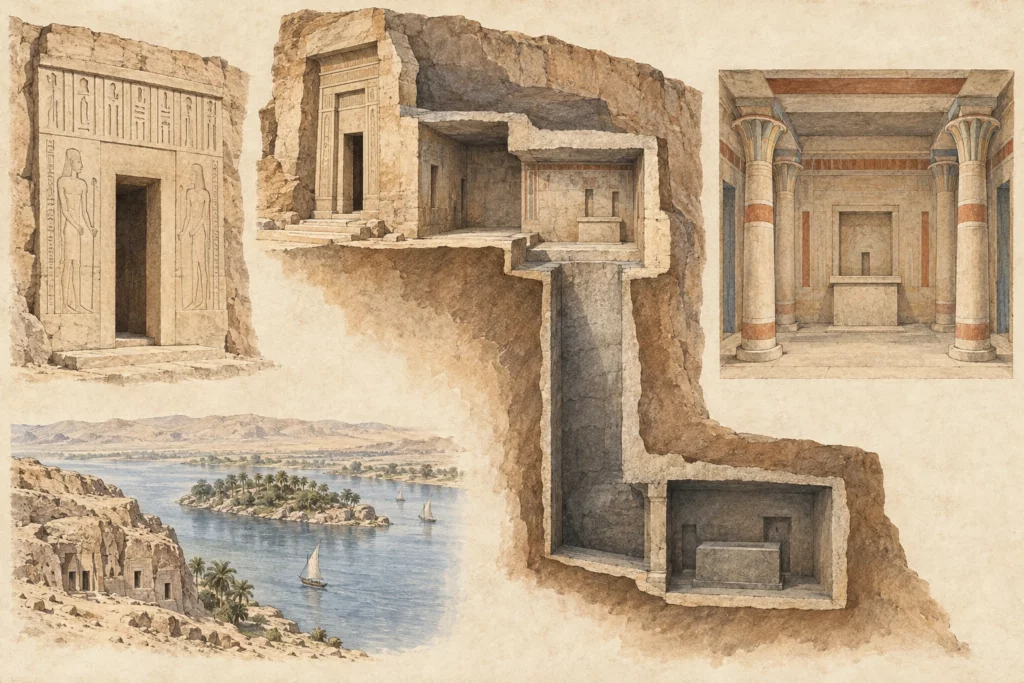
The tombs are cut at several levels in the rocky slopes. A façade leads into a chapel intended for the rites, while shafts and burial chambers provide the burial proper. The plans, dimensions and treatment of the surfaces vary according to period and owner. At the end of the Old Kingdom, the great governors’ tombs dominate the landscape; mud-brick mastabas have also been identified at the foot of the escarpment for other dead. In the Middle Kingdom, more elaborate chapels bear witness to another phase.
Chronology and building phases
Use of the site began in the Old Kingdom and continued over many centuries. A study of the 6th Dynasty therefore cannot be used to date a Middle Kingdom chamber. The governors’ biographies and titles change with the reigns and the administrative structures. Modern research has assigned numbers to the tombs, recorded the inscriptions and studied the relationships between owners. The sectors of the slope and the monuments of the summit have had their own phases; the dome that gives the site its modern name postdates pharaonic Egypt.
History and functions
The funerary chapel was the place of memory and of offerings for the dead. The inscriptions proclaimed his titles, his family ties and the deeds he wished to be remembered. Some scenes show the officials surrounded by servants, ritualists and ka priests, according to the analysis published by the IFAO. These images inform us about social organisation, but they remain choices of funerary representation. They do not on their own allow all the inhabitants of Elephantine to be reconstructed, nor official function to be confused with daily reality.
Excavations and the history of research
The ministry’s description clearly locates the cemetery in relation to Elephantine and recalls its long period of use. The article by Christelle Mazé in the Bulletin de l’Institut français d’archéologie orientale compares the rock-cut tombs with the burials on the island and the mastabas of the lower slope. The prosopography of the 6th Dynasty, also published by the IFAO, gathers the titles attested in the numbered tombs. The study of a particular person or relief must go back to the number of the monument and the published text, since a synthesis of the necropolis is not enough to prove an individual attribution.
State of preservation and research questions
The rock, the reuse and the loss of decoration alter the state of the chapels. The accompanying panorama is a created watercolour, not a photograph of the site.
Sources
Main sources: Egyptian Ministry of Tourism and Antiquities, ‘Qubbat Al-Hawa Cemetery’, https://egymonuments.gov.eg/archaeological-sites/qubbat-al-hawa-cemetery-1/; Institut français d’archéologie orientale, ‘Prosopographie de la Qoubbet el-Haoua (VIe dynastie)’ (in French), https://www.ifao.egnet.net/bifao/116/7/; Christelle Mazé, article on the burials of Elephantine and Qubbet el-Hawa (in French), https://www.ifao.egnet.net/bifao/116/07; study of the biography of Sarenput I (in French), https://www.ifao.egnet.net/bifao/103/09/ (consulted on 27 September 2026).