1790–1832 | Reading hieroglyphs once more
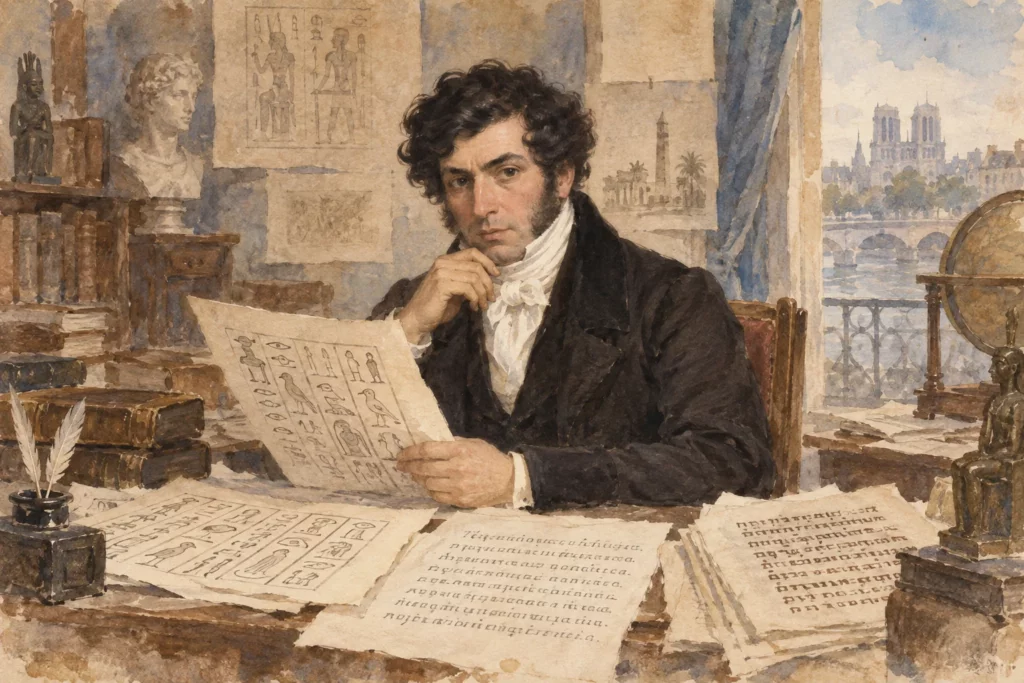
On the morning of 14 September 1822, I am at my brother’s, in the rue Mazarine, in Paris. On the table are drawings of inscriptions that an architect has just sent me from Egypt. In a cartouche, a disc, then two signs I already know. The disc is the sun, Ra, as it is still called in Coptic. The other two are read m and s. Ra-mes-s: Ramses. An Egyptian name, written in hieroglyphs, read with sounds. Not a Ptolemy, not a Cleopatra, not a Greek: a pharaoh.
Around midday, I run to the Institut de France, where Jacques-Joseph works in the library. ‘I’ve got it!’ (translated from the French). My family later said that I collapsed just afterwards, and that it took me several days to recover. The letter to Bon-Joseph Dacier, permanent secretary of the Académie des inscriptions (the Academy of Inscriptions), is dated 22 September. It is read out on the 27th.
I was thirty-one years old. I had been searching since childhood, or almost. I was born in Figeac in 1790; at eleven, my brother brought me to Grenoble. In the autumn of 1802, he took me to the prefecture, to see Joseph Fourier, back from the French expedition to Egypt. He showed us his antiquities. It is said that I stood speechless before him. That is possible: I was eleven. Then came Greek, Hebrew, Arabic and above all Coptic, the last form of the language of the pharaohs, which I worked at for years as others practise their scales.
The Rosetta Stone? It was in London. I studied it from copies, like the obelisks, the papyri and everything the travellers brought back. Thomas Young (in French) had read part of the name of Ptolemy before me and made good progress on Demotic. I acknowledged it less willingly than I should have. My method went further than his, it is true. It did not start from nothing.
What I understood can be said in a few words. Hieroglyphs are not an alphabet, nor are they a series of silent symbols. They combine signs that record sounds with others that make the meaning clear. It took years of comparisons, of cartouches set side by side, of wrong readings corrected by other texts. I liked to repeat that one can never be wary enough of oneself. The Précis du système hiéroglyphique, in 1824, set out what the letter of 1822 had only opened up.
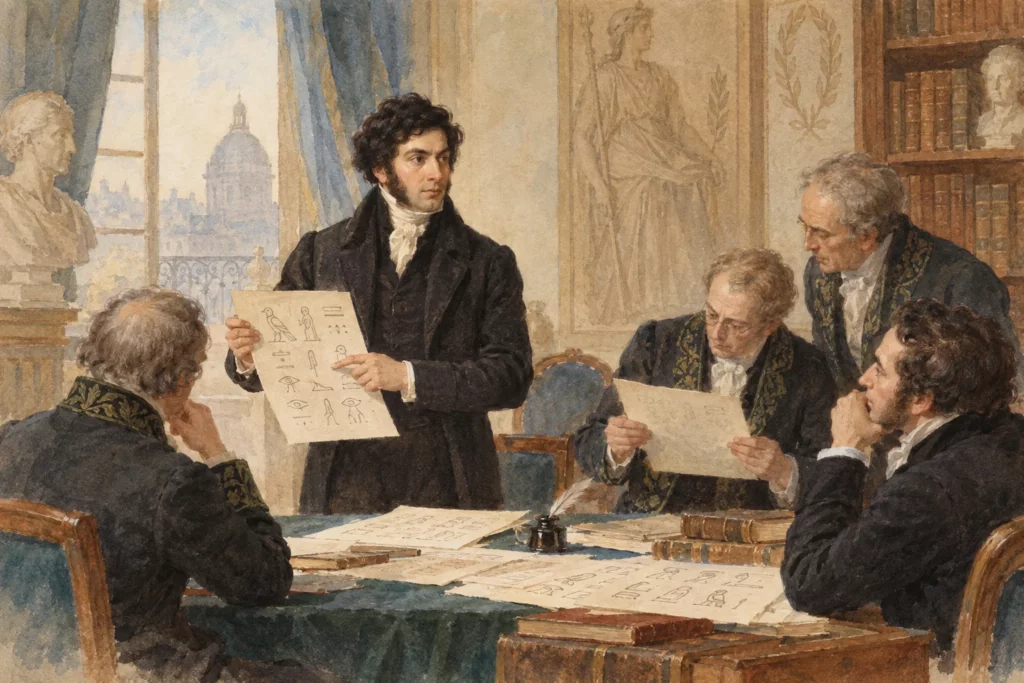
In 1826, I became curator of Egyptian antiquities at the Louvre. The new museum opened in 1827. Many of its objects came from the collections of European consuls and dealers, bought as a whole. I classified them, labelled them, explained them. How each one had left Egypt was hardly asked at the time. It is asked today, and rightly so.
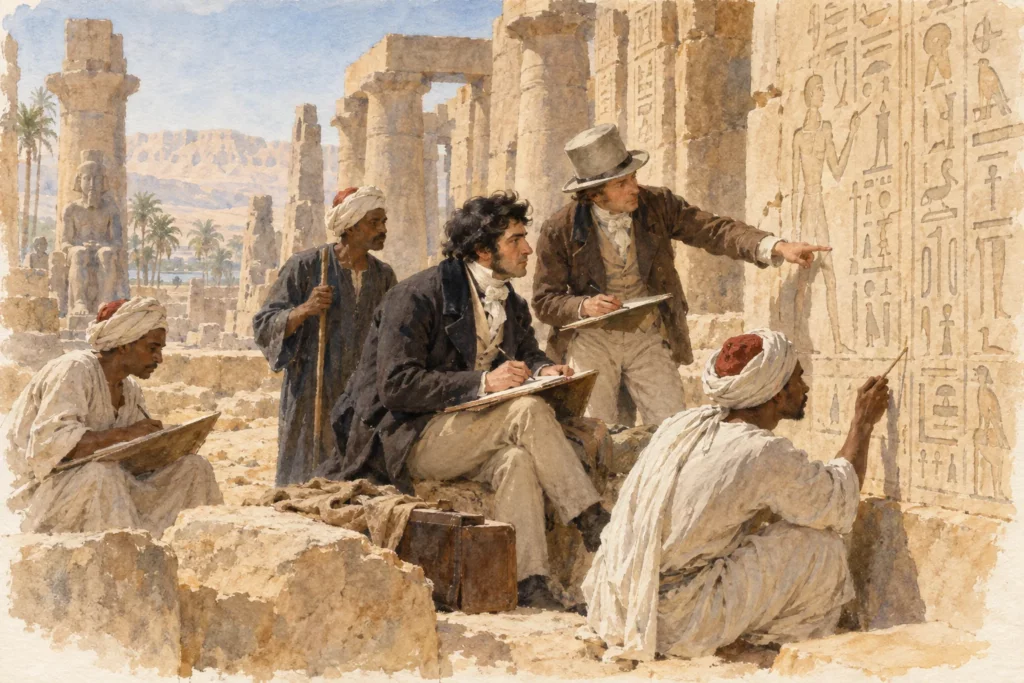
In 1828 and 1829, at last, Egypt itself, with Ippolito Rosellini (in French) and a Franco-Tuscan expedition. Sixteen months sailing up the Nile, copying texts, recording scenes, checking on the stone what I had guessed on paper. The Egyptian boatmen, guides and workmen made this work possible; our accounts rarely name them. Some walls confirmed my readings. Others corrected me.
Back in France, the first chair of Egyptian archaeology was created for me at the Collège de France. I gave only a few lectures there. I died in Paris on 4 March 1832, at the age of forty-one. My notebooks, my records and my unfinished grammar passed to others, who would correct my values, write the grammars and read what I did not have time to read.
A first-person narrative reconstructed from the sources cited. The watercolours are contemporary evocations; the signs they show are not exact scholarly transcriptions and they do not attest specific individual encounters.
Main sources
- Collège de France, Champollion and his methods (in French)
- Collège de France, the work before Champollion (in French)
- Collège de France, the exhibition ‘Champollion 1822’ (14 September and the Lettre à M. Dacier) (in French)
- Jean Capart, Champollion, lecture at the Académie royale de Belgique, 3 May 1922 (in French)
- Musée du Louvre, Champollion’s Egyptian museum (in French)
- Musée du Louvre, history of the Egyptian collections (in French)
- Musée du Louvre, portrait of Champollion