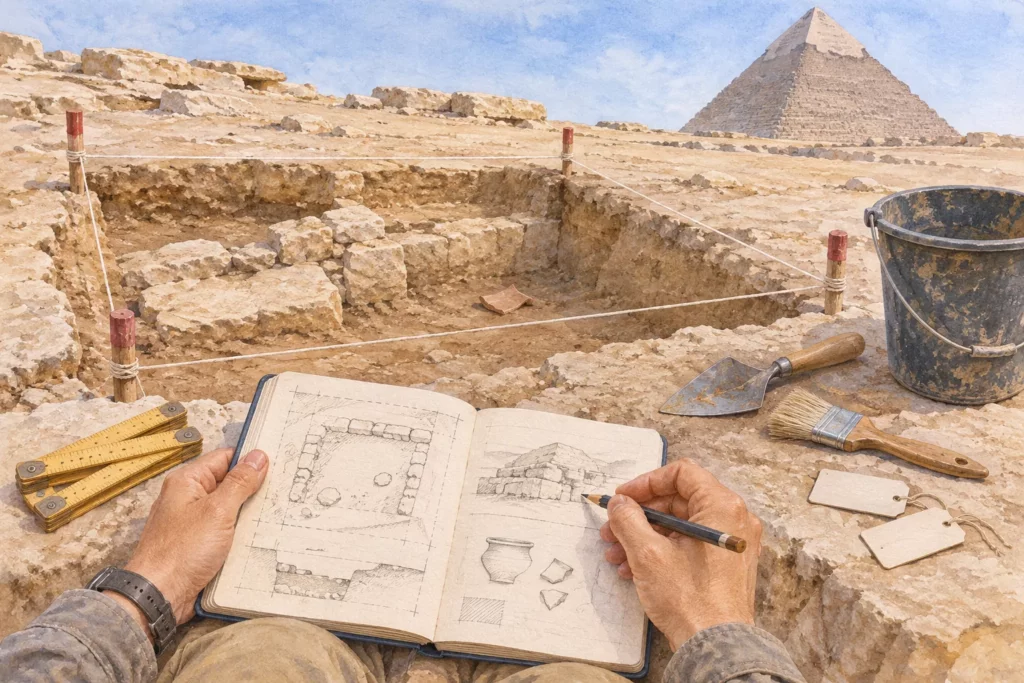
On 14 April 1990, south of the Wall of the Crow, at Giza (in French), an American tourist falls from her horse. The animal has stumbled on a mudbrick wall half buried in the sand. The head guard of the pyramid of Chephren runs to alert the archaeologist in charge of the plateau. He arrives, looks, and declares, by his own account, that these are the tombs of the pyramid builders. He is forty-two years old. His name is Zahi Hawass.
He was born in 1947 in el-Abidiya, a village near Damietta. As a child, he wanted to be a lawyer. In the end he studied Greek and Roman archaeology at the University of Alexandria (in French), and the state, which at the time gave a job to every graduate, made him an inspector of antiquities. Tuna el-Gebel, Abydos, Abu Simbel, then Giza: he learnt the trade on other people’s sites, supervising foreign excavations. In 1980, he obtained a Fulbright scholarship to the University of Pennsylvania, where in 1987 he defended a thesis on the funerary installations of Cheops, Chephren and Mycerinus.
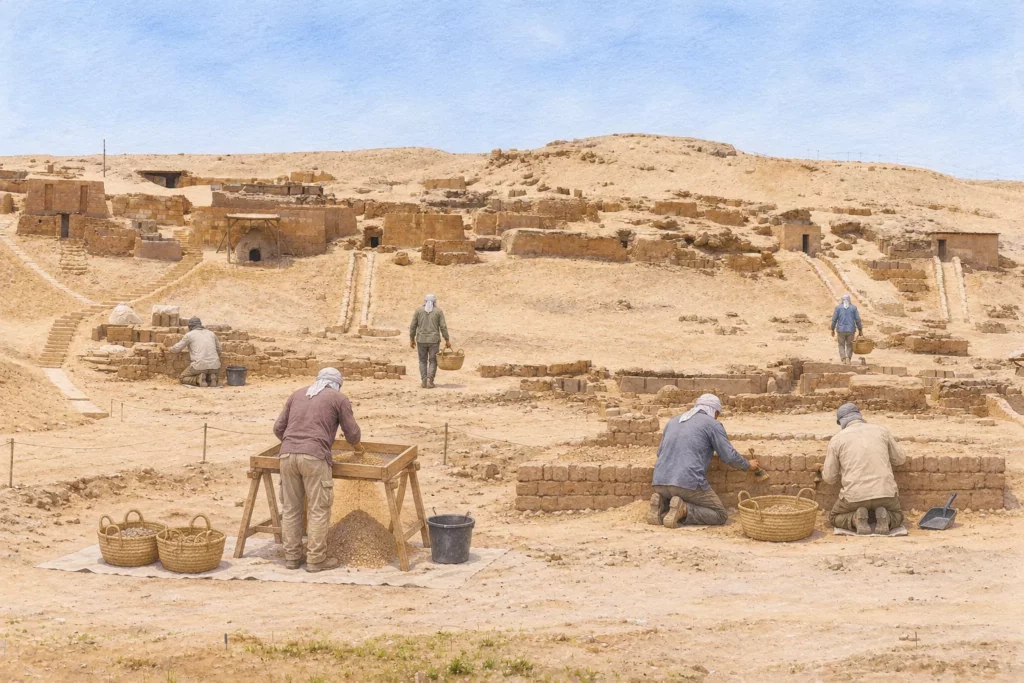
The discovery of 1990 came at the right moment. For years, Hawass had been looking south-east of the Sphinx for traces of the men who had built the pyramids. Hundreds of small tombs were then uncovered, with their jars of bread and beer, followed by the workers’ town excavated by Mark Lehner. Enough to bury, once again, the old legend of the slaves. The phrase has been used a great deal, on television above all; the study of the skeletons, inscriptions and installations took years and involved many other researchers.
In 2002, he became secretary general of the Supreme Council of Antiquities. He had control over excavations, museums and permits, and he used it. He called for the return of objects that had left the country, from the Rosetta Stone to the bust of Nefertiti. He had the royal mummies scanned and announced discoveries in the oases, at Saqqara and in the Valley of the Kings. He was seen everywhere, felt hat on his head, in documentaries all over the world. For many, he was ancient Egypt in person. That is his strength, and it is the criticism made of him: behind every announcement there are inspectors, restorers, workers and specialists whose names fade into the background.
2011 changed everything. At the end of January, in the midst of the revolution, he became the first Minister of State for Antiquities. He resigned at the beginning of March, returned in April, and Prime Minister Essam Sharaf removed him on 17 July. His statements in the first days in favour of keeping Hosni Mubarak in power, his very personal management and the anger of young unemployed archaeologists all weighed against him. Those months are part of his story. They do not erase thirty years in the field.
Since then, he has excavated, published, given lectures and remained, at nearly eighty, the best-known face of Egyptology. His communication methods can be debated, and colleagues have criticised him for announcing faster than he published. Yet he has made heard an idea that the stories of exploration had long forgotten: the sites of Egypt belong first of all to Egyptians, and it is for them to excavate them, to look after them and to tell their story.
Note on the reconstruction. This biographical account summarises the sources cited. The three drawings are artistic reconstructions, neither period photographs nor documentary portraits attesting a likeness.
Sources
- Zahi Hawass, ‘The Discovery of the Tombs of the Pyramid Builders at Giza’ (account of the discovery of 14 April 1990)
- Zahi Hawass’s website, biography
- Encyclopædia Britannica, entry on Zahi Hawass
- State Information Service (Egypt), entry on Zahi Hawass
- Archaeology, feature on Zahi Hawass
- Smithsonian Magazine, ‘The Fall of Zahi Hawass’, 2011
- Egyptian Ministry of Tourism and Antiquities, appointment as UNWTO ambassador