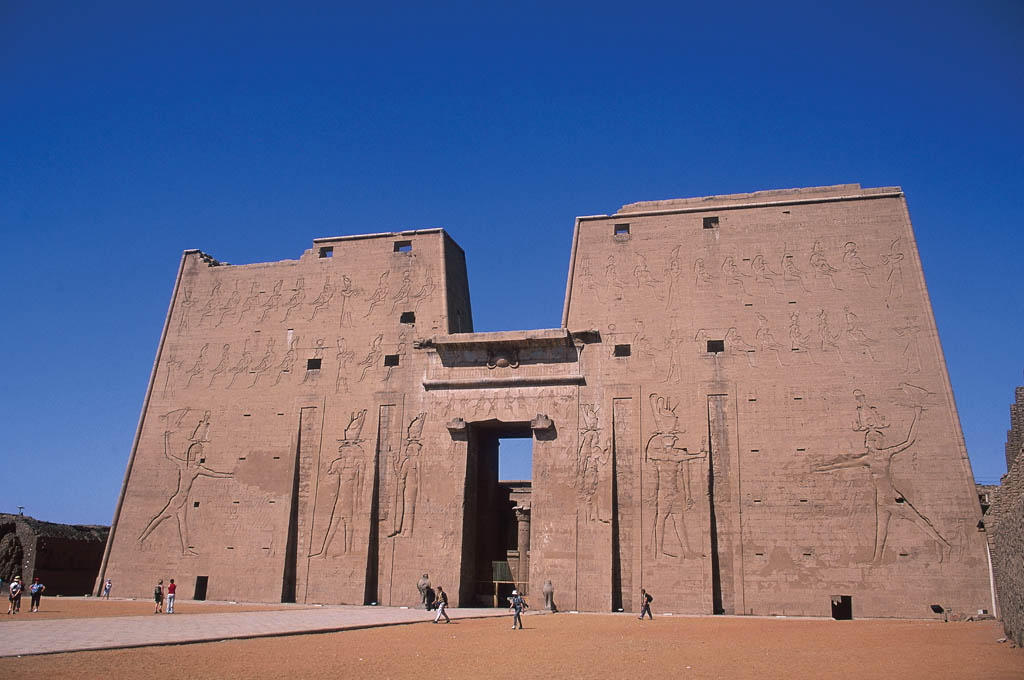
At Edfu, the facade of the temple first stops you in your tracks. Then it invites you in. You leave the light of the town for a court, columns and halls ever more withdrawn. The stone seems to guide the eye as surely as the path underfoot.
The town around the sanctuary
Edfu remains a Nile town; its temple does not stand in an empty desert. Dedicated to Horus, the present building was begun under Ptolemy III in 237 BC and completed in 57 BC. The houses that built up around and over some parts helped to preserve its decoration. Partly cleared in the 19th century, it now keeps the memory of a sanctuary and of a town that went on living.
The falcon at the threshold
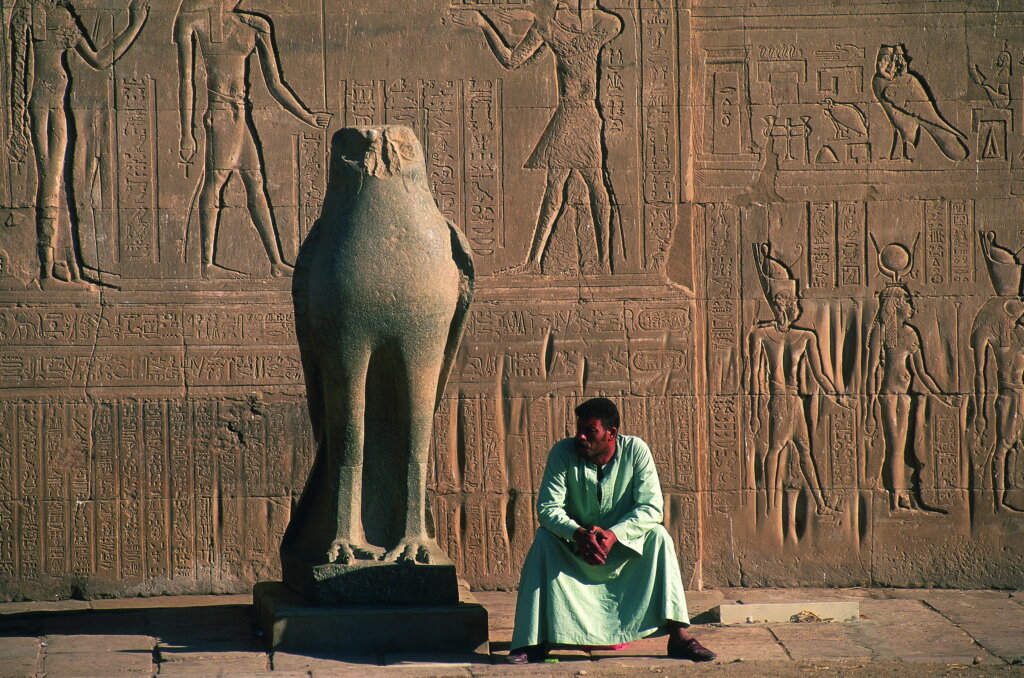
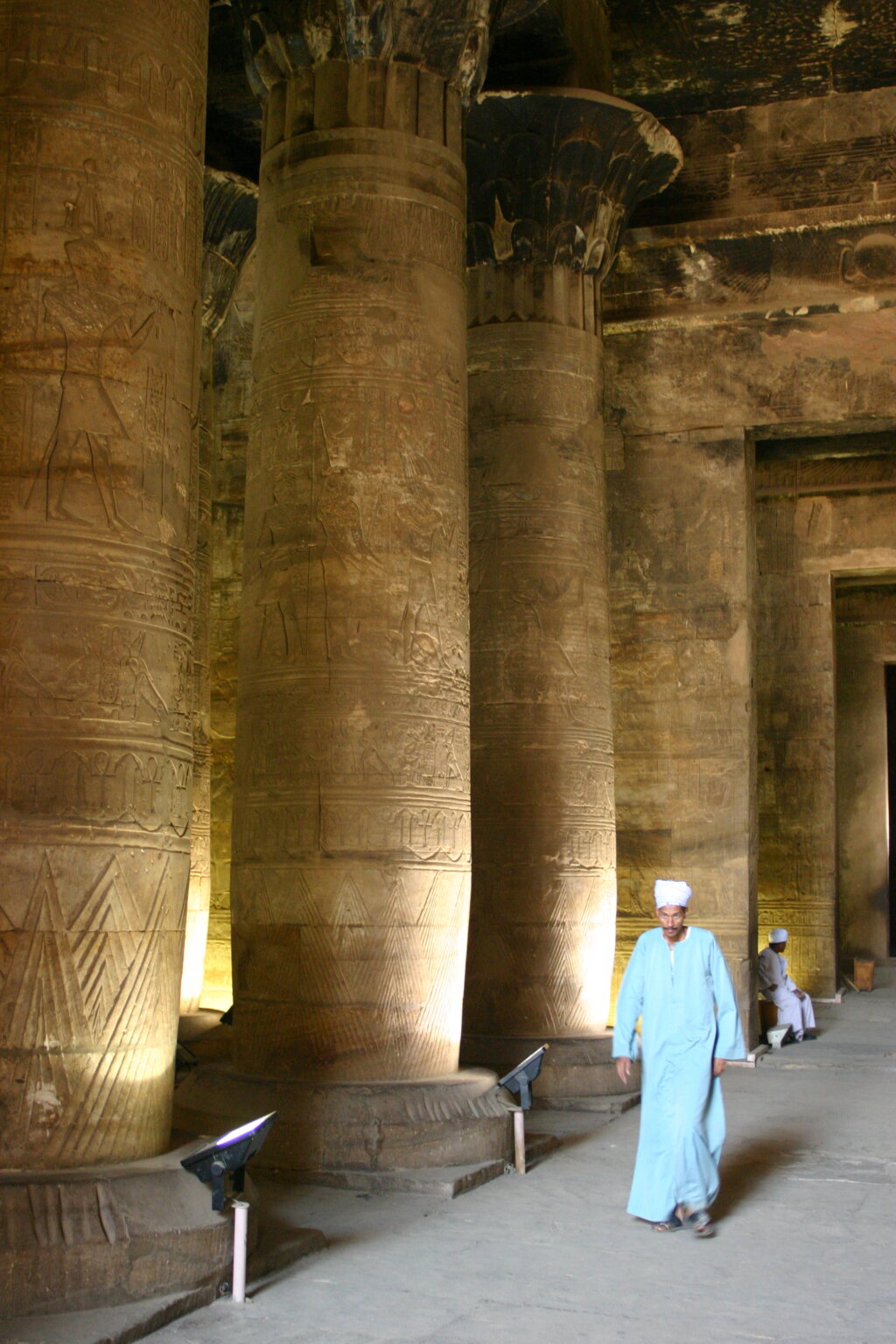
The falcon statues give Horus an immediate presence. Behind the pylon opens a great court lined with columns. Light flows freely there before growing scarcer. Capitals, reliefs and doors mark each stage. You need to slow down to feel this progression: the monument is not understood as an isolated facade, but as a sequence of linked spaces.
The way of the festivals
In the inner halls, the carved scenes speak of rites, foundations and meetings between gods. The festival that joined Horus of Edfu and Hathor of Dendera is a reminder that the temple also belonged to a network of places and journeys. The goddess’s barque came all the way here. The sanctuary thus had a calendar, routes and visitors long before today’s.
What the stone preserves
The temple owes part of its fame to its state of preservation. That does not mean that everything it told is immediately legible to us. The inscriptions need to be studied; the reliefs follow the language peculiar to Egyptian temples. In the relative coolness of the halls, what you understand above all is how the architecture separated, then joined, the open court and the most sacred spaces.
Back into the light
On the way out, the noise of the town returns with the sun. The stone falcon takes its place again at the threshold, while the Nile flows on a little further away. Edfu leaves the memory of a route governed by light and by rites. Following the river on the map, you can continue to Kom Ombo and its two parallel axes.