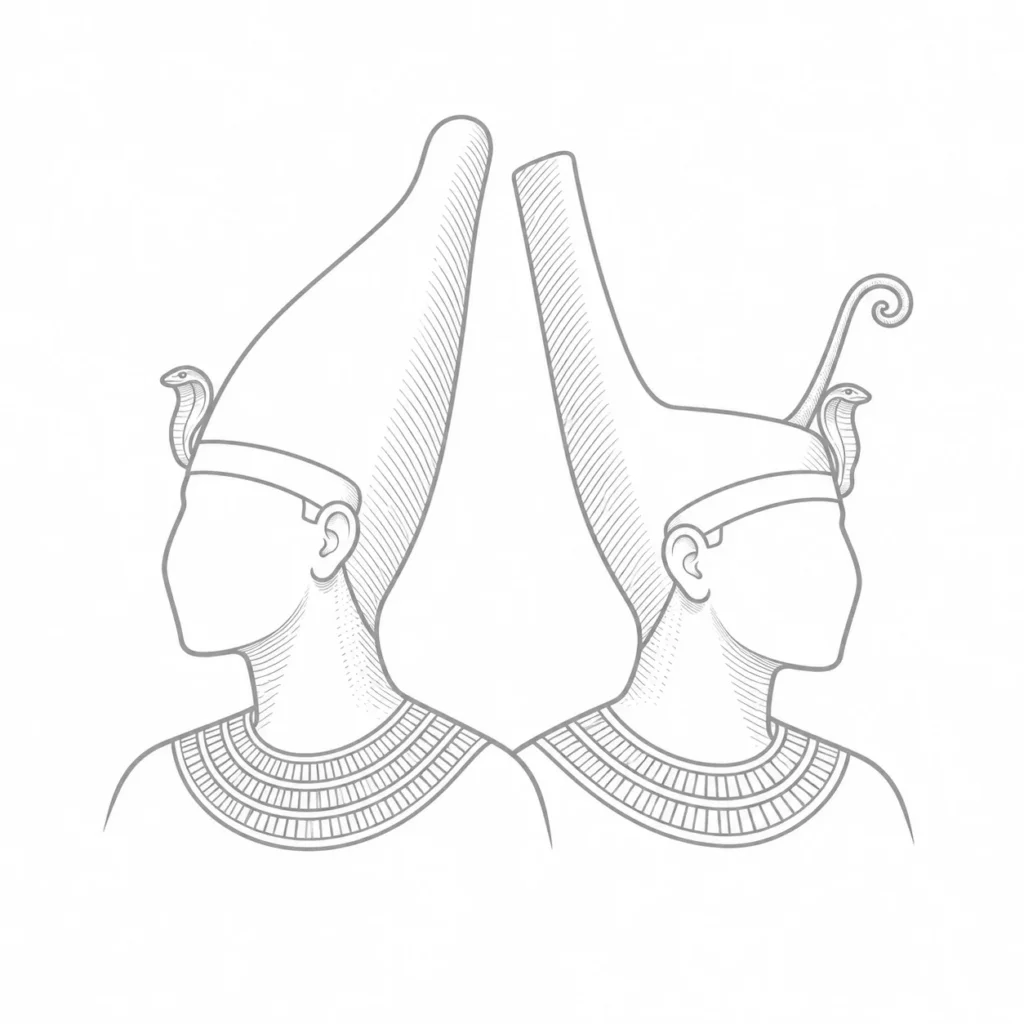
A child born between two political traditions
Summer of 30 BC. Somewhere on the road south, a boy of sixteen or seventeen turns back. His mother had sent him towards Ethiopia and India with a treasure, Plutarch tells us. His tutor, Rhodon, has persuaded him to return: Octavian, he assures him, wants to give him back the kingdom. The boy is called Ptolemy Caesar. The Alexandrians call him Caesarion, ‘little Caesar’.
He was born in 47 BC, the son of Cleopatra VII (in French) and, according to his mother, of Julius Caesar. His name sums up the whole programme: the name of a Lagid king, the name of a Roman. In Egypt, hieroglyphic inscriptions present him very early as pharaoh and son of Caesar. Caesar himself never seems to have recognised him publicly. A parentage that opens every door in Alexandria (in French) is not worth much in the Forum. In the chronology of Ian Shaw (Oxford, 2000), his reign runs from 44 to 30 BC.
The place of Cleopatra VII
A child does not govern. Everything goes through his mother. After the death of Ptolemy XIII (in French), Cleopatra first shares the throne with another brother, Ptolemy XIV, then she sets her son at her side. The documents do not agree on the exact date of this association; UCL Digital Egypt sees it displayed above all in 34 BC. In the end it hardly matters. Caesarion is not asked to decide; he is asked to embody two inheritances at once, that of the Lagids and that of Caesar.
Caesar dead, a disputed inheritance
For in Rome, Caesar’s heir already exists: Octavian, his great-nephew, adopted by will after the assassination of March 44 BC. Two heirs for a single name: the situation could not last. It broke out in the autumn of 34 BC. In the gymnasium of Alexandria, before the crowd, Mark Antony proclaimed Caesarion the legitimate son of Caesar and ‘king of kings’. Plutarch reports that in Rome the ceremony was found theatrical, arrogant and hostile to the city. Octavian could not have asked for more. These accounts must be read with caution: almost all of them were written on the side of the victors.
A pharaoh depicted in Egypt
The Egyptians, for their part, saw something else. On the rear wall of the temple of Hathor at Dendera (in French), the queen and her son face the gods, dressed as pharaohs, in the purest style of the temples. UCL Digital Egypt also mentions a stela from Memphis on which he appears with his mother, and a small statuette head kept in the Petrie Museum in London. These images say nothing about what a boy of about ten was thinking. They show only that the old pharaonic staging still worked, at the very end of the dynasty.
Coins and the spread of the image
Coins go where temples do not: to soldiers, to merchants, to the ports. The British Museum keeps a bronze coin struck in Cyprus with the portrait of Cleopatra; the museum’s commentary considers that the child may appear on it with her. A hypothesis, not a certainty. If it is right, Caesarion had two faces: the pharaoh of the temples, for the priests and the gods, and the little prince of the coins, for everyone else.
Actium, Alexandria and death
September 31 BC: Antony and Cleopatra are defeated at Actium. On 1 August 30 BC, Octavian enters Alexandria. Antony takes his own life, then Cleopatra. There remains the boy who had been called back on the road. Octavian hesitates, Plutarch tells us again. The philosopher Areios then slips him a line twisted from Homer: ‘Too many Caesars is not a good thing’ (translated from the French). Caesarion is put to death. With him ends the dynasty founded by Ptolemy I (in French), and Egypt becomes a Roman province.
The last Lagid and the limits of his biography
He is often called ‘the last pharaoh’. That is going a little fast: after him, the Roman emperors still had themselves depicted as pharaohs on the walls of Egyptian temples, at Dendera as elsewhere. Caesarion is the last king of the house of the Ptolemies, which is already no small thing. For the rest, everything we know about him was written or carved by others: his mother, the priests, Antony, his enemies. Of him, there remains neither a letter nor a word.
Main sources
- UCL Digital Egypt, Ptolemy XV Caesarion
- UCL Digital Egypt, Cleopatra VII and her monuments
- British Museum, coin of Cleopatra from Cyprus and iconographic commentary
- UCL Digital Egypt, Egypt after 30 BC
- Plutarch, Life of Antony, 54 and 81 (English translation by Bernadotte Perrin)
- Crowns drawn from the statue of Senusret I and the relief of Ahmose, Metropolitan Museum of Art.
Reference works
- Ian Shaw (ed.), The Oxford History of Ancient Egypt, Oxford, Oxford University Press, 2000, chronology pp. 479–483
- Aidan Dodson and Dyan Hilton, The Complete Royal Families of Ancient Egypt, London, Thames & Hudson, 2004